Advancing Blind Analysis and Noise Simulation for Detector Optimization in High-Energy Physics
This commentary discusses the necessity of blind analysis for initial detection in physics, emphasizing a thorough understanding of detector noise behaviors. It highlights the importance of developing comprehensive detector noise simulators that encompass a variety of noise types, beyond Gaussian and white noise, including burst-like noises. Additionally, the commentary addresses the challenges of noise background estimation, particularly the impact of systematic errors and changing detector conditions. Finally, it notes the progress in joint analysis programs for networked detectors and their value for single detector searches.

Advancing Blind Analysis and Noise Simulation for Detector Optimization in High-Energy Physics
E N D
Presentation Transcript
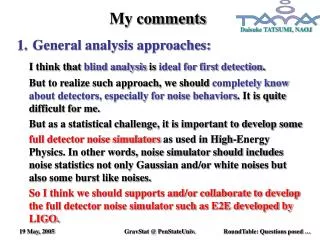
My comments • General analysis approaches: I think that blind analysis is ideal for first detection. But to realize such approach, we should completely know about detectors, especially for noise behaviors. It is quite difficult for me. But as a statistical challenge, it is important to develop some full detector noise simulators as used in High-Energy Physics. In other words, noise simulator should includes noise statistics not only Gaussian and/or white noises but also some burst like noises. So I think we should supports and/or collaborate to develop the full detector noise simulator such as E2E developed by LIGO. GravStat @ PenStateUniv.
My comments 2. Noise background estimation: In this topic, I think the most important things are systematic errors. How to make a model of the noise behavior, and how to estimates the uncertainties due to time variations of detector conditions are unsolved problems for me. I hope such questions concerned to systematic error are also discussed in this conference. GravStat @ PenStateUniv.
My comments 3. Validation of the results of a network or a detector: For network analysis, especially for coincidence analysis, joint search programs look good and are in progress steadily. This is good example as statistical challenge. In addition, such joint analysis makes great feedback to the search of single detector. GravStat @ PenStateUniv.