Enhancing Real-Time Video Streaming Through ABR and VBR Techniques
300 likes | 432 Vues
This document explores the implementation of Real-Time Available Bit Rate (rt-ABR) technology and its synergy with Variable Bit Rate (VBR) for MPEG-2 video streams. It covers the design and analysis of virtual sources and destinations in ATM networks, highlighting how dynamic compression parameters can optimize video delivery. Key discussions include the switch algorithm for minimal delay, the importance of explicit rate signaling, and the effects of long-range dependent traffic models in both terrestrial and satellite network simulations.


Enhancing Real-Time Video Streaming Through ABR and VBR Techniques
E N D
Presentation Transcript
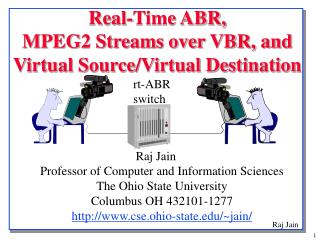
rt-ABRswitch Real-Time ABR, MPEG2 Streams over VBR, and Virtual Source/Virtual Destination Raj JainProfessor of Computer and Information SciencesThe Ohio State UniversityColumbus OH 432101-1277http://www.cse.ohio-state.edu/~jain/
Overview • Presentation at ATM Forum • Modeling MPEG2 Transport Streams over VBR background • Virtual Source/Virtual Destination Design Analysis
Current Cell Rate Explicit Rate The Explicit Rate Scheme • Sources send one RM cell every n cells • The RM cells contain “Explicit rate” • Destination returns the RM cell to the source • The switches adjust the rate down • Source adjusts to the specified rate
1. ATM Forum Presentation • “Real-Time ABR: Proposal for a New Work Item,” ATM Forum Contribution 96-1760, December 1996, ftp://netlab.ohio-state.edu/pub/jain/atm96-1760.txt • Contribution co-sponsored by Samsung and Lucent Technologies • AT&T seems to be working on it also • Accepted as a work item for Traffic Management V5.0
Video over ABR: How? • Compression parameters can be dynamically adjusted to match the available bandwidth real-time ABR or rt-ABR • With proper switch algorithm, ABR queues in the switches are very small Negligible delay in the network • Any switch algorithm with fast transient response and queue control can loosely guarantee low delay through the switch
Scheduling and Buffering Issues • Weighted max-min fairness: Allocate rates to flows in proportion to their weights Higher rate sources are treated preferentially • Buffering at the sources and acceptable loss Equivalent bandwidth MCR Minimum acceptable quality is guaranteed • Internet does not provide MCR. ABR does.rt-ABR video will be much better
2. MPEG2 Streams over VBR • MPEG2 over ATM Overview • Modeling MPEG2 Transport Streams over VBR • Simulation Results for Terrestrial Networks • Simulation Results for Satellite Networks • Ref: “Performance of TCP over ABR with Long-Range Dependent VBR Background Traffic Over Terrestrial and Satellite ATM Networks,” ATM Forum Contribution, 97-0177, February 1997, ftp://netlab.ohio-state.edu/pub/jain/atm97-0177.txt
MPEG-2 Over ATM VideoSource Elementary Encoder Packetizer SystemsLayer Mux UncompressedStream ElementaryStream PES* AudioSource Elementary Encoder Packetizer TransportStream * PES = Packetized Elementary Stream ATM cells 188-byte packets
I B B P B B P B B I P Elementary Stream • Elementary stream: Sequence of I, P, B frames • Individually coded I frames - LargeTransmission time = 4 to 5 frame display time • Predictively coded P frames - MediumTransmission time = 0.5-1 frame display time • Bidirectionally coded B frames - SmallTransmission time = 0.2 frame display time
Timestamps in MPEG2 • Frames may contain a presentation timestamp. • To synchronize the clocks, a sample of system clock is sent every 80s to 100 msMPEG2 Program Clock Reference (MPCR)We use MPCR instead of PCR (Peak Cell Rate) • MPCRs are used by a phase lock loop Rate between MPCRs must be constant MPCR Rate Time
MPEG2 Traffic Characteristics • Single Program Transport Stream • Piecewise CBR • Rate changes only at MPCRs • Inter-MPCR interval is randomStandard allows 80s to 100 ms intervalMost implementations change only 20 to 100 ms • Rate values have a long-range dependence
VBR Traffic Model SPTS 1 • VBR background = Sum of k transport streams • Each transport stream has • a random inter-MPCR interval = Uniform(20,100) • a random long-range dependent rates(Fractional Gaussian Noise) SPTS 2 SPTS k
VBR Model (Cont) • Maximum bandwidth demand = 15 MbpsMinimum bandwidth demand = 0 Mbps Random numbers below 0 or above 15 are ignored (Pruning)(Alternative choices: clipping or exponentiation were rejected). (a) Gaussian (b)ClippingMin{Max{0, x}, 15} (c) Exponentiation Min{2x, 15} (d) Pruning
ABR Source 1 ABR Destination 1 ABR Source n ABR Destination n VBR Stream VBR Destination n Source + VBR WAN Configuration • All links 155 Mbps • If VBR background , sum of k independent SPTSsVarious mean and variances, H=0.8 • All traffic unidirectional; Large file transfer application • 15 ABR sources, RTT =30 ms, Feedback Delay = 10 ms Switch Switch 1000 km 1000 km 1000 km
ABR Source 1 ABR Destination 1 ABR Source n ABR Destination n VBR Stream VBR Destination n Source + VBR Satellite Configuration 1 • 15 ABR sources, RTT =550 ms, Feedback Delay = 10 ms Switch Switch 1000 km 1 km
ABR Source 1 ABR Destination 1 ABR Source n ABR Destination n VBR Stream VBR Destination n Source + VBR Satellite Configuration 2 • 15 ABR sources, RTT =550 ms, Feedback Delay = 550 ms Switch Switch 1 km 1 km
Summary of Results • MPEG2 compressed video = piecewise CBR,long-range dependent rate, random inter-MPCR intervals • ABR with appropriate switch algorithm can handle the randomness in ABR capacity • With ERICA+ and Infinite TCP Traffic: • Queue lengths < 3 × Feedback delay • Efficiency close to the maximum possible. • Queues are similar to those with deterministic VBR
3. Virtual Source/Virtual Destination • Overview of VS/VD • Implementation Guidelines • Simulation results • Ref: “Virtual Source/Virtual Destination: Design Considerations,” ATM Forum Contribution, 96-1759, December 1996, ftp://netlab.ohio-state.edu/pub/jain/atmf/atm96-1759.ps
S D EFCI EFCI RM RM EFCI EFCI EFCI EFCI RM RM RM RM Segment-by-Segment Control • Virtual source/virtual destinations (VS/VD) follow all notification/control rules • Can be hop-by-hop S D • Virtual dest/sources maintain per-VC queues.
Why Implement VS/VD? • Isolates users from the networkOr, isolates different networks • Allows proprietary protocol in the intermediate cloud • Shorter control loops improve performance • Little cost to implement VS/VD if per-VC queueing and scheduling is already in the switch.(Queues shared by multiple VCs aren’t sufficient.)
Switch Queue Structure (Logical) Switch Switch ABR1 ABR1 ABR ABR Link 1 Link 1 ABR2 ABR2 VBR VBR per-VCQueues per-Class Queues Link Queues
10 Mbps 100 Mbps Design Decisions • What is the VC’s rate? • What is the input rate? • Does a link affect current loop or previous loop? • When to calculate the VAL?
What is the VC’s Rate? 1. CCR in FRM1 2. CCR in FRM2 = ACR2 3. Measured source rate in the previous loop=VC’s input rate to per-VC queue (Not yet analyzed) 4. Measured source rate in the next loop =VC’s input rate to per-class queue 1 3 4 2 10 Mbps 100 Mbps
10 Mbps 100 Mbps What is the Input Rate? 1. Input rates to per-VC queues 2. Input rate to per-class queue 1 2 ABR1 ABR ABR2
2 10 Mbps 100 Mbps 1 Effect of link congestion • Which link affects which loop?E.g., Effect of Link 2 congestion: 1. Change ER1 Previous loop only 2. Change ACR2 Next loop only 3. Change ER1 and ACR2 Both loops
Allocated Rate Update Frequency • When should the rate allocated to a VC be calculated? (Applies only to the previous loop)This is normally done on receiving a BRM in a switch or on turning around an FRM in a destination 1. On receiving BRM2 2. On turning around FRM1 3. Both FRM1 FRM2 10 Mbps 100 Mbps BRM1 BRM2
Design Decisions: Summary • Four Decisions: 1. What is the VC’s rate: 4 alternatives 2. What is the input rate: 2 alternatives 3. Effect of link congestion: 3 alternatives 4. Allocated rate update frequency: 3 alternatives • Total 4 × 2 × 3 × 3 = 72 combinations • Some of these combinations do not work • Recommendation: Measured VC rate from per-Class Queue, per-class input rate, Control both loops, VC’s allocation updated at FRM1 and at BRM2
Summary of Results • Virtual Source/Virtual destination: • Reduces response time during first round-trip • Good for satellites 24,000 miles Switch Switch Source Destination
10 Mbps 100 Mbps • VS/VD does improve the stability of the network.Some cases that diverged with basic ERICA converge with VS/VD. • VS/VD increases throughput slightly due to reduced response time and reduced convergence time. • The effect of VS/VD depends upon the switch algorithm. • In VS/VD situations, ACR and actual rates are very different. Cannot rely on CCR field. Must measure VC’s rate.
Summary • Real-time ABR accepted by the industry as a work-item for the next version of ATM Forum Traffic Management • MPEG2 Video is piece-wise CBR • Developed VS/VD implementation guidelines • VS/VD may help in satellite paths. • Results are quickly being communicated to industry.