Modeling Changes in Whole Bone Strength from Muscle Loads: A Finite Element Analysis Approach
This research presents a computational model to analyze variations in whole bone strength due to muscle-generated loads, emphasizing the effects of individual muscle forces and external forces on bone geometry and density. By utilizing Finite Element Analysis (FEA) on a multi-bone, multi-muscle leg system, we can quantify the influence of applied forces on femur strength and shape. Results demonstrate how muscle forces modify bone characteristics, revealing potential methods for preventing bone loss related to aging or limited mobility.

Modeling Changes in Whole Bone Strength from Muscle Loads: A Finite Element Analysis Approach
E N D
Presentation Transcript
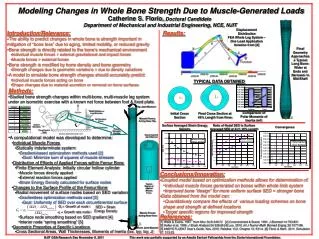
Modeling Changes in Whole Bone Strength Due to Muscle-Generated Loads Catherine S. Florio,Doctoral Candidate Department of Mechanical and Industrial Engineering, NCE, NJIT Displacement Distribution FEA Whole Leg System – One Load Application Iteration from [6] Final Geometry Approaches a Typical Long Bone: Wider at Ends and Narrower in Mid-Shaft TYPICAL DATA OBTAINED 6% Improvement Hip Joint Moment Radial Variation of Load Direction 4 Comparison of Polar Moments of Inertia (m4) Initial Cross Section Final Cross Section at 45% Length from Knee 5 6 Net Resultant Force Tibia Femur Muscle Forces Acting Near Hip 7 3 1 8 System Boundary Typical Applied Joint Moment 9 2 Foot Rigid, Fixed Plate Surface Averaged Strain Energy Density Ratio of Nodal SED to Surface Averaged SED at X=Y, 45% Length Torso Fixed to Table Convergence Femur Strength Studied Based on experimental study in [1] Typical Region of Applied Muscle Force Gi = Growth at node i SED = Strain Energy Density ai = Growth rate node i Muscle Forces Acting Near Knee Knee Joint Moment • Introduction/Relevance: • The ability to predict changes in whole bone is strength important in mitigation of “bone loss” due to aging, limited mobility, or reduced gravity • Bone strength is directly related to the bone’s mechanical environment • Individual muscle forces + external gravitational and impact forces • Muscle forces > external forces • Bone strength is modified by bone density and bone geometry • Strength changes due to geometric variations > due to density variations • A model to simulate bone strength changes should accurately predict: • Individual muscle forces acting on bone • Shape changes due to material accretion or removal on bone surfaces Results: • Methods: • Studied bone strength changes within multi-bone, multi-muscle leg system under an isometric exercise with a known net force between foot & fixed plate. • A computational model was developed to determine: • Individual Muscle Forces • Statically indeterminate system: • Gradient-based optimization methods used [2] • Goal: Minimize sum of squares of muscle stresses • Distribution of Effects of Applied Forces within Femur Bone • Finite Element Analysis: Initially circular hollow cylinder • Muscle forces directly applied • External reaction forces applied • Strain Energy Density calculated for surface nodes • Changes to the Surface Profile of the Femur Bone • Radial movement of surface nodes based on SED variation • Gradientless optimization methods used [3] • Goal: Uniformity of SED over each circumferential surface • Surface node smoothing based on SED gradient [4] • Interior node “spring smoothing” [5] • Geometric Properties at Specific Locations • Cross Sectional Areas, Wall Thicknesses, Moments of Inertia (Ixx, Iyy, Ixy, J) • Conclusions/Innovation: • Coupled model based on optimization methods allows for determination of: • Individual muscle forces generated on bones within whole limb system • Improved bone “design” for more uniform surface SED = stronger bone • Data obtained from the model can: • Quantitatively compare the effects of various loading schemes on bone shape and strength at defined locations • Target specific regions for improved strength References:[1] Wells & Evans. 1987. Hum Mov Sci 6:349-72 [2] Crowninshield & Brand. 1981. J Biomech 14:793-801 [3] Heller et al. 1999. J Strain Analysis 34:326-36 [4] Luo. 2010. Int J Numer Meth Biomed Engng. 26:1077-86. [5] ANSYS FLUENT User’s Guide. Nov. 2010. Release 13.0. Chapter 12. 631-4. [6] Florio & Narh. 2011. Simulation 87: 313-33. NJIT GSA Research Day November 9, 2011 This work was partially supported by an Amelia Earhart Fellowship from the Zonta International Foundation