Biocompatible Porous Silicon Quantum Dots for Targeted Drug Delivery in Cancer Therapy
This research explores the use of intrinsically luminescent porous silicon particles for targeted delivery of molecular drug payloads, specifically doxorubicin, to human cervical cancer (HeLa) cells. Our study demonstrates the successful loading of superparamagnetic iron oxide nanoparticles alongside the drug. Under the influence of a magnetic field, these particles increase drug concentration at tumor sites, effectively enhancing cytotoxicity. This innovative approach may revolutionize localized cancer treatment strategies.

Biocompatible Porous Silicon Quantum Dots for Targeted Drug Delivery in Cancer Therapy
E N D
Presentation Transcript
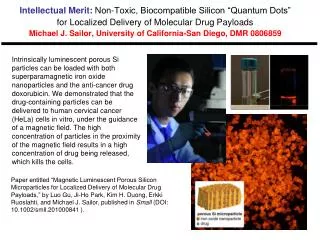
Intellectual Merit: Non-Toxic, Biocompatible Silicon “Quantum Dots” for Localized Delivery of Molecular Drug PayloadsMichael J. Sailor, University of California-San Diego, DMR 0806859 Intrinsically luminescent porous Si particles can be loaded with both superparamagnetic iron oxide nanoparticles and the anti-cancer drug doxorubicin. We demonstrated that the drug-containing particles can be delivered to human cervical cancer (HeLa) cells in vitro, under the guidance of a magnetic field. The high concentration of particles in the proximity of the magnetic field results in a high concentration of drug being released, which kills the cells. Paper entitled “Magnetic Luminescent Porous Silicon Microparticles for Localized Delivery of Molecular Drug Payloads,” by Luo Gu, Ji-Ho Park, Kim H. Duong, Erkki Ruoslahti, and Michael J. Sailor, published in Small (DOI: 10.1002/smll.201000841 ).
Broader Impacts: High School Student Anna Kornfeld Simpson wins the Davidson Prize for her Chemical Sniffing Robot Michael J. Sailor, University of California-San Diego, DMR 0806859 Using a LEGO MINDSTORMS™ robotic kit and a chemical nanosensor she helped develop in the laboratory of NSF-funded researcher Michael J. Sailor at the University of California, San Diego, Patrick Henry High School student Anna Kornfeld Simpson designed, built, programmed, and tested a robot that was able to crawl around the floor of a building sniffing for chemical spills. For her achievement, Anna won 1st Prize in the 2009 California State Science Fair and the 2010 Davidson Prize, a $25,000 national award recognizing exceptionally gifted students. Anna worked on her project with NSF-funded graduate student Anne Ruminski. Anna assembling her robot Anna with graduate student mentor Anne Ruminski and Prof. Sailor Anna tests the robot’s ability to locate an alcohol spill