Gymnosperm vs Angiosperm
Gymnosperm vs Angiosperm. Flowers, Fruits and Seeds too. Seed Plants. Seed plants are plants that produce seeds in order to reproduce. Two types of seed plants exist today: Gymnosperms “gymno” – meaning “naked” “sperm” – meaning “seed” Angiosperms “angio” – meaning “vessel”

Gymnosperm vs Angiosperm
E N D
Presentation Transcript
Gymnosperm vs Angiosperm Flowers, Fruits and Seeds too
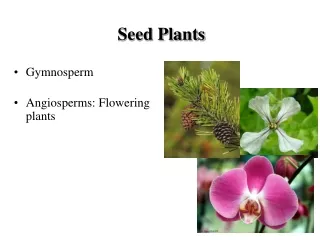
Seed Plants • Seed plants are plants that produce seeds in order to reproduce. • Two types of seed plants exist today: • Gymnosperms • “gymno” – meaning “naked” • “sperm” – meaning “seed” • Angiosperms • “angio” – meaning “vessel” • “sperm” – meaning “seed”
Gymnosperm Characteristics • Oldest of seed plants • Used to be most abundant type of plant on the planet, now only four groups exist: • Cycads • Conifers • Ginkgoes • Gnetophytes • Have needle-like or scale-like leaves
Gymnosperm Examples • Cycads • Live mainly in tropic regions • Look like a palm tree but produce a cone • Cycad Cone
Gymnosperm Examples • Conifers • Cone bearing plants • Have needles for leaves • Most diverse group • Pines • Sequoias • Junipers • Western White Pine
Gymnosperm Examples-Conifers con’t. • Sequoia Juniper
Gymnosperm Examples • Gnetophyte • Can grow in hot deserts or in tropical rain forests • Can live to 1,000 years • Welwitschia
Gymnosperm Reproduction • Most gymnosperms produce cones • Male – makes pollen • Female – contains the ovule • Ovule contains the egg cell which, after fertilization, becomes a seed • Fertilization – the joining of a sperm and an egg
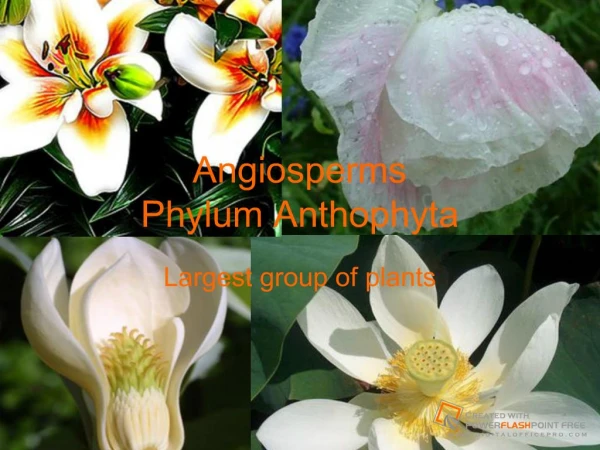
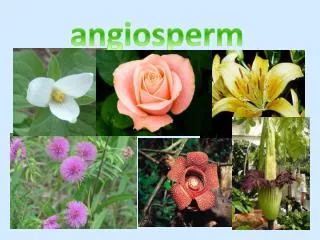
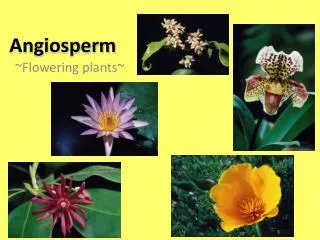
Angiosperm Characteristics • ALL angiosperms produce flowers • ALL angiosperms have seeds that are enclosed in fruits (the “vessel”)
Angiosperm Examples • Apple blossom • Wheat
Angiosperm Examples • Lily • Tomato
Flower Structure • The flower is the reproductive structure of an angiosperm. • Sepals – leaf like structures that protect the developing flower • Petals – generally the most colorful part of the flower • Color, size, shape and odor attract pollinators
Flower Structure - Petals • Bright blue and violet – bees • Red, pink, fuchsia or purple – Hummingbirds • Yellow, orange, pink and reds - Butterflies
Flower Structure – Stamen • Stamen – the MALE part of the flower, has two parts: • Anther – Makes pollen • Filament – holds up the anther
Flower Structure - Pistil • Pistil – the FEMALE part of the flower, has three parts • Stigma – has a sticky surface to catch pollen • Style – tube – like structure the pollen travels down • Ovary – contains the ovules (eggs) and becomes the fruit after fertilization • Ovules (eggs) – become the seeds after fertilization
Fruits • The fruit is a ripened ovary used to protect the developing seeds, enable the seeds to be carried to a new location and nourish the seeds when deposited on the ground • If it has a seed, it is a FRUIT (according to science) • Peppers, cucumbers, avocadoes are fruits
Seeds • Seeds – ovules that become fertilized • Carry the genetic information for a new plant
Seed Dispersal • Seeds are dispersed or spread in 4 main ways: • Wind • Water • Animal • Fur • Feces • Expulsion