Exploring Knowledge Issues: Understanding Belief and Perception
Knowledge issues are fundamental questions about how we understand the world and ourselves. They challenge our beliefs and examine the reasons behind them, focusing on the acquisition, search for, and acceptance of knowledge. This task encourages the identification and evaluation of knowledge issues through real-life scenarios. By developing our own questions and categorizing them, we delve into essential aspects of knowledge, such as memory and sense perception, while justifying our understanding of these complex issues.

Exploring Knowledge Issues: Understanding Belief and Perception
E N D
Presentation Transcript
Identifying Knowledge Issues Mr Field
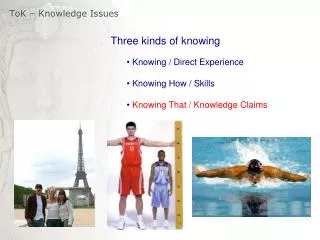
What are knowledge Issues? • IB Definition: • ‘Knowledge issues are questions that directly refer to our understanding of the world, ourselves and others, in connection with the acquisition, search for, production, shaping and acceptance of knowledge.’ • In simple terms, questions that: • Question what we believe, our reasons for believing it and whether these are good reasons
Some Examples…. • Questions not about what we know but how we know it TASK • For each knowledge issue, see if it meets the criteria mentioned on the previous page. • Try to develop your own knowledge issues and see if they meet these criteria.
Evaluating Knowledge Issues • To Do: • Cut out the cards and categorise them according to the above • Make sure you can justify why you have put each item where you have.
Coming Up With Knowledge Issues • Think of a real-life situation • Brainstorm AoK/ WoK it may touch upon • Formulate 2-3 possible questions • Use the criteria on the previous slide to refine the strongest question
For example: • A disagreement with a friend over what had been said the night before • Sense-perception, language, memory, History, Science • Can we trust memory? • How does sense perception affect memory? • Can we trust memory and sense-perception in science? • Should we trust eye-witness accounts in history? • Given the fallibility of memory and sense-perception, to what extent should we trust eye-witness accounts in history? • Think of a real-life situation • Brainstorm AoK/ WoK it may touch upon • Formulate 2-3 possible questions • Use the criteria on the previous slide to refine the strongest question