
Economic Impacts of Honeybee Diseases: Varroatosis and Tracheal Mites
This overview discusses the economic impacts of major honeybee diseases, particularly Varroatosis caused by the Varroa destructor and infections by the tracheal mite (Acarapis woodi). Varroatosis poses a significant threat to beekeeping, often killing entire colonies, especially affecting drone brood. Treatment methods are complicated, involving chemical, physical, and cultural approaches. While tracheal mites have less severe economic effects, they can cause notable issues such as wing deformity in bees. Learn more about these challenges and treatments through our video resources.

Economic Impacts of Honeybee Diseases: Varroatosis and Tracheal Mites
E N D
Presentation Transcript
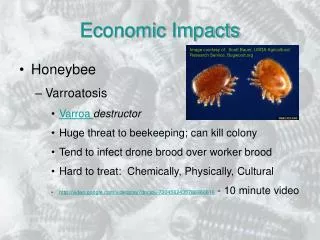
Economic Impacts Image courtesy of: Scott Bauer, USDA Agricultural Research Service, Bugwood.org • Honeybee • Varroatosis • Varroa destructor • Huge threat to beekeeping; can kill colony • Tend to infect drone brood over worker brood • Hard to treat: Chemically, Physically, Cultural • http://video.google.com/videoplay?docid=-7304562435786960616 - 10 minute video
Economic Impacts • Honeybee • Tracheal mite (Acarapis woodi) • Spread to U.S. in 1984 • Enter tracheal system of adults • Only 3% annual loss so not a major pest • May cause wing deformity and improper flying • Treatment: Chemical, Resistant bees, Crisco patties • http://video.google.com/videoplay?docid=-530248919698814753 – 9 minute video Photo by Lilia De Guzman
Sampling Technique for Tracheal Mites Image from USDA pamphlet We will try this in lab if bees available
Bibliography Continued • Bauer, Scott. 2006. USDA Image Gallery. Varroa mites image. http://www.ars.usda.gov/is/graphics/photos/jun02/k5111-7.htm • Caron, Dewey M. 1999. Honey Bee Biology and beekeeping. Wicwas Press, LLC. Cp. 20. • De Guzman, Lilia. 2006. USDA Image Gallery. Tracheal mite image. http://www.ars.usda.gov/is/graphics/photos/dec04/k5069-23.htm • Sanford, M.T. And H.L. Cromroy. 2007. Univ. of Florida. Featured Creatures: Varroa mites & tracheal mites. http://creatures.ifas.ufl.edu/misc/bees/varroa_mite.htmhttp://creatures.ifas.ufl.edu/misc/bees/tracheal_mite.htm • Shimanuki, Hachiro, and David A. Knox. 2000. Diagnosis of Honey Bee Diseases. U.S. Department of Agriculture, Agriculture Handbook No. AH–690, 61 pp. http://www.ars.usda.gov/is/np/honeybeediseases/honeybeediseases.pdf • USDA. 2006. Tracheal Mite Dissection Video. http://www.ars.usda.gov/pandp/docs.htm?docid=14370