
Interest Groups
E N D
Presentation Transcript
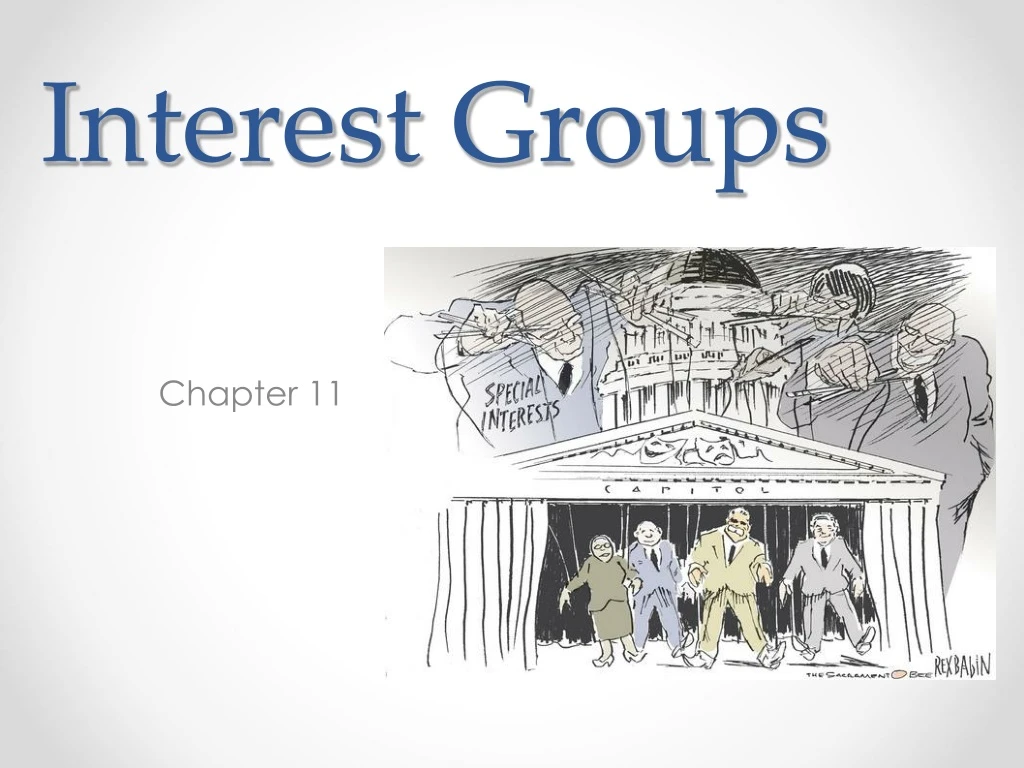
Interest Groups Chapter 11
The Role and Reputation of Interest Groups • Defining Interest Groups • Organization of people with shared policy goals entering policy process at one of several points. • Sharing a cause for the purpose of “influencing” the gov’t at all levels, all branches. • Political Parties run candidates for office. Political parties goals are to “make” policy. . • A modern day version of Madison’s factions • Interest groups are policy specialists; political parties policy generalists.
The Role and Reputation of Interest Groups • Why Interest Groups Get Bad Press • Writers of Constitution disliked organized factions. • Dishonest lobbyists get more press than honest ones- even though there are far more honest lobbyists. • Term “lobbying” in general has negative connotations.
Theories of Interest Group Politics- Pluralism • Definition: • Politics is mainly competition among groups, each pressing for its own preferred policies. • Many centers of power and many diverse, competing groups. • No group wins or loses all the time. • Interest groups are a linkage institution between people and government.
Theories of Interest Group Politics- Pluralism • Groups compete • No group becomes too dominant • Groups play by rules • Groups weak in one resource can rely on another resource. • Lobbying is open to all, not just those groups with the most resources.
Theories of Interest Group Politics- Elitism • Definition: • Societies are divided along class lines and the upper-class elite will rule. • Power is not equally divided among groups, some have much more. • Largest corporations and unions hold the most power.
Theories of Interest Group Politics- Elitism • Power is strengthened by the system of interlocking directorates of corporations and other institutions. • Corporate elites are willing to lose minor policy battles, but work to win on major policy issues . • Lobbying is a problem because it benefits few at the expense of many.
Theories of Interest Group Politics: Hyperpluralism • Groups are so strong that government is weakened (gridlocked)- extreme or exaggerated form of pluralism • Members of government try to make all groups happy and this leads to • Large Bureaucracies • Programs that multiply • Bloated budgets • Created a system of sub-governments or iron triangles/issues networks
Iron Triangles and Issue Networks • Iron triangles are formed in specific policy areas among congressional committees, agencies, and interest groups. • Issue network may be replacing iron triangles. • Issue networks are groups that are connected through a policy issue.
What Makes an Interest Group Successful? • The Surprising Ineffectiveness of Large Groups • Free-Rider problem: Some people don’t join interest groups because they benefit from group’s activities without officially joining. • The bigger the group, larger the free-rider problem. • Large groups are difficult to keep organized.
What Makes an Interest Group Successful? • Small groups are better organized and more focused on group’s goals. • Consumer groups have a difficult time getting significant policy gains because benefits are spread over entire population. • Groups that can provide selective benefits sometimes overcome the problem.
What Makes an Interest Group Successful? • Intensity • Single-Issue groups: Groups that focus on a narrow interest and dislike compromise. • Groups may focus on an emotional issue, providing them with a psychological advantage. • May be more likely to use protests and other means of political participation than traditional interest groups that use lobbyists.
What Makes an Interest Group Successful? • Financial Resources • Not all groups have equal amounts of money. • Monetary donations usually translate into access to politicians, like phone calls and meetings. • Wealthier groups don’t always win in the policy arena.
How Groups Try to Shape Policy • Lobbying “communication by someone other than a citizen acting on his own behalf, directed to a governmental decision maker with the hope of influencing his decision.”
How Groups Try to Shape Policy • Lobbyists are source of information. • Lobbyists can help politicians plan political strategies for legislation. • Lobbyists can help politicians plan political strategies for reelection campaigns. • Lobbyists can provide ideas and innovations that can be turned into policies for which the politician can take credit.
How Groups Try to Shape Policy • Electioneering • Direct group involvement in election process. • Political Action Committee (PAC): Used by corporations and unions to donate money directly to candidates. • 527s and 501(C)(3)s are used to generate independent expenditures. • Groups may give to both sides. • Groups can help with campaigns.
How Groups Try to Shape Policy • Litigation • If an interest group fails in one area, courts may be able to provide remedy. • Interest groups can file amicus curiae briefs in court cases to support position. • Class Action lawsuits permit small groups file on behalf of a much larger group.
How Groups Try to Shape Policy • Going Public • Groups try and cultivate good public image. • Groups use marketing strategies to influence public opinion of group and its issues. • Groups will purchase advertising to motivate the public about an issue. • Groups use grassroots lobbying to get members to advocate on behalf of their interest.
Conventional Participation • Voting • Letter writing • Contact with Representatives • Working on Campaigns • Campaign Contributions
Unconventional Participation • Boycotts • Marches • Sit-ins • Demonstrations • Violence
Types of Interest Groups • Economic Interests • Labor (AFL-CIO) • Agriculture • Business (NAM, Chambers of Commerce) • Environmental Interests (Greenpeace, Sierra Club) • Equality Interests (NAACP, NOW) • Consumer and Public Interest Lobbies (ACLU, Pro-Life, Pro-Choice, Center for Responsive Politics)