Download

1 / 18
190 likes | 355 Vues
Ancient Greek civilization, renowned for its monumental contributions to art, architecture, drama, philosophy, and government, profoundly shaped Western culture. The Parthenon, an exemplar of classical architecture, symbolizes Greek artistic achievement. The 5th century BC was a golden age for drama, with performances in the Theater of Dionysus, where tragic and comic plays were staged during the Dionysia festival. This era also saw Athens at its zenith, alongside its rivalry with Sparta culminating in the Peloponnesian War, which temporarily weakened Athens.

E N D
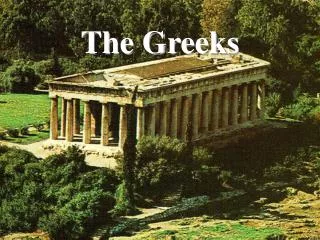
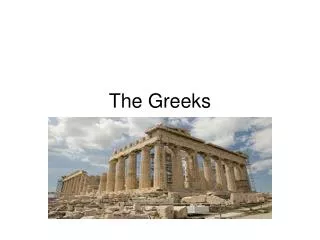
GREEKS • Ancient Greek ideas about art, architecture, drama, philosophy, and government greatly influenced Western Civilization. • Among the most influential of Greek cultural achievements is the Parthenon in Athens, an outstanding example of classical architecture.
GREEKS • Greek dramas set structural and thematic styles emulated by great Western playwrights such as William Shakespeare.
Athens dominated the Greek city-states in the 5th century B. C. Rival Sparta led the smaller Spartan Confederacy. The two sides fought in the Peloponnesian War (431-404 B. C.), and Athens lost, leaving it temporarily weakened.
The Greek Theater • 5th Century B. C. • Golden Age of Greek Drama • Dramatic festivals were popular • People witnessed tragic and comic plays
Theater of Dionysus • Dionysia was an annual festival in honor of the god Dionysus • Theater of Dionysus was an open-air Theater with room for fifteen thousand spectators
Theater of Dionysus • carved out of a stone hillside • looked like a semicircle with steeply rising tiers of seats
Theater of Dionysus • At the bottom was the rounded orchestra or performance area where the chorus sang and danced
Theater of Dionysus • Behind the orchestra was an open, almost bare, stage where actors spoke their lines from behind huge masks
Theater of Dionysus • Male actors performed all the roles • Actors switched masks to play a number of roles – both female and male