A Statistical Model of Criminal Behavior: Understanding Burglar Dynamics and Attractiveness
This study presents a statistical model to analyze the behavior of burglars within a two-dimensional lattice framework. Focusing on the dynamic and static attractiveness of potential targets, the model illustrates how past victimization influences a site's likelihood of future burglary. It emphasizes the mechanisms behind repeat victimization and the probabilistic decisions of offenders as they navigate their choices. By examining the interaction between criminal agents and their environments, the research deepens our understanding of crime patterns and the spread of disorder in communities.

A Statistical Model of Criminal Behavior: Understanding Burglar Dynamics and Attractiveness
E N D
Presentation Transcript
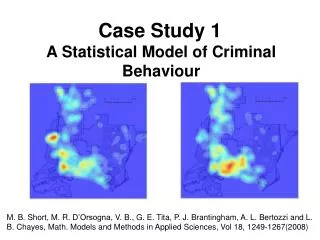
Case Study 1 A Statistical Model of Criminal Behaviour M. B. Short, M. R. D’Orsogna, V. B., G. E. Tita, P. J. Brantingham, A. L. Bertozziand L. B. Chayes, Math. Models and Methods in Applied Sciences, Vol 18, 1249-1267(2008)
Crime is complex The spreading of disorder: K. Keizer, S. Lindenberg, and L. Steg, Science (2008)
Repeat Victimisation Bowers, Johnson, Domestic Burglary Repeats and Space-Time Clusters. European journal of criminology (2004)
The Discrete Model Burglars Homes, s = (i,j) Two dimensional lattice, grid spacing l Attractiveness: If a site is burgled, the dynamic component of attractiveness is adjusted as follows: Appear at rate which is constant through space Decides to burgle site with probability: If the criminal agent chooses not to burgle the current location, it moves to a neighbouring house with probability: Otherwise – if the criminal agent decides to burgle, it will then leave the system, and affect the attractiveness of the victimised site Static component Dynamic component
The Discrete Model M. B. Short et al Math.Models and Methods in App. Sci, Vol 18, 1249-1267(2008)
Assesses attractiveness of neighbouring sites New burglar generated Moves probabilistically Burglar removed from the system Dynamic attractiveness of local sites increase A = 1 q = 1/6 B(t) B(t) q = 1/6 B(t) A = 1 q = 3/6 A = 3 B(t) B(t) A = 1 q = 1/6
The Discrete Model With thanks to Toby Davies