Download
1 / 16
160 likes | 288 Vues
Why do we eat? Our food choices are influenced by physical needs for survival, growth, energy, and fitness, alongside environmental factors like culture, family, and advertising. Emotions also play a significant role in our eating habits, whether it's boredom, happiness, or depression. Nutrients are classified into carbohydrates, fats, proteins, water, vitamins, and minerals, each serving vital roles in our body. This guide explores the importance of a balanced diet, the Food Guide Pyramid, and tips for making healthier food choices.

E N D
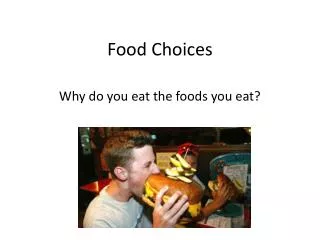
Why do we eat? • Physical need survival, growth, energy, & fitness • Environment culture, family, advertising, time & $$ • Emotions boredom, depression, happiness
Nutrient Types • Carbohydrates • Fiber • Fats • Proteins • Water • Vitamins • Minerals
Carbohydrates • Bodies main source of energy • 55-65% of diet should come from Carbo’s • Mainly found in plant sources • There are two types: 1. Complex...(vegetables, legumes, pasta, seeds, and nuts) 2. Simple...(sugars, fruits, some veggies, milk)
Fiber • It is a complex carbohydrate • It serves no nutritional value, can not be digested by humans. • Aids the body in digestion. • Can decrease your chances of cancer and heart disease • excellent source to lose weight.
Lipids...does not dissolve in water. 2 types.... (1)Saturated(animal fat) (2)Unsaturated(Veggie) The more hydrogenated the more saturated. 30% diet from fat 2X energy as Carbo’s & Protein Carry fat-soluble vitamins A,D,K in blood. add flavor to food. take longer to digest cushions organs FATS
Cholesterol • Fatlike substance, but not a nutrient. • Can form fat deposits on wall of arteries Atheroselerosis • Body can make without aid of diet. • Functions in the body: 1. essential for cell wall construction 2. needed to make hormones and bile 3. transmission of nerve impulses • 2 types of cholesterol: 1. Low-Density Lipoproteins (BAD) 2. High-Density Lipoproteins (GOOD)
Protein • used for building & maintaining all body tissue. • Help regulate body processes... enzymes, hormones & antibodies • 10-15% of diet should come from protein • sources include...meat, fish, poultry, eggs, dairy products, nuts, seeds, legumes
Vitamins • Micronutrients • regulate many vital body processes • they trigger reactions with enzymes. • 2 groups... 1. water-soluble 2. fat-soluble
Water • Work as catalyst • H20 most essential • 2/3 body is water • transports food & waste • lubricates joints & mucous membranes • regulates body temp. • you need 10 cups/day
Minerals • Elements needed in small quantities for forming healthy bones and teeth, and for regulating many body processes.
Food Guide Pyramid • Grains-Orange band-make half your grains whole-at least 6oz. every day • Vegetables-Green band-Vary your veggies-2.5 cups every day • Fruits-Red band-Focus on fruits- 2 cups each day * Oils (Yellow band) are not a food group, but you need some for good health. Get your oils from fish, nuts, and liquid oils such as corn oil, soybean oil and canola oil. • Milk-Blue band-Get your calcium rich foods-3 cups every day • Meat, fish, poultry, nuts, legumes-Purple band Go lean with protein-Eat 5.5 oz. every day
Extra Credit Options • http://www.mypyramid.gov/mypyramid/index.aspx
What kind of diet should you have? • Low in fat, especially saturated fat. • Eat plenty of vegetables, fruit, grains • control sugar intake, use in moderation • use low salt and sodium
When should you eat? • 3-5 times a day • breakfast most important • try to snack on something healthy between meals. • If you eat out, choose a meal that is not high in fat. • When you are hungry, fuel your body