Understanding Key Concepts of Sound: Frequency, Intensity, Pitch, and Articulation
This guide outlines essential concepts about sound, including frequency (Hertz), intensity, pitch, and articulation. Explore how high pitch correlates with frequent waves while low pitch indicates infrequent waves. Understand loudness through amplitude and dynamics. Delve into the timbre that gives each sound its unique character and discover the envelope of sound, including attack and decay. Learn about different articulation methods including staccato, legato, and arco techniques used in string instruments for enhanced musical expression.

Understanding Key Concepts of Sound: Frequency, Intensity, Pitch, and Articulation
E N D
Presentation Transcript
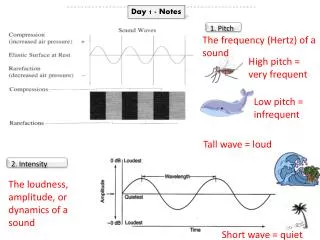
Day 1 - Notes The frequency (Hertz) of a sound 2. Intensity 1. Pitch High pitch = very frequent Low pitch = infrequent Tall wave = loud The loudness, amplitude, or dynamics of a sound Short wave = quiet
C D
A change in dynamics that is sudden – no gradual change. 4. Timbre 3. Terrace Dynamics Tone color or waveform – What makes one sound different from another Harmonic Series ALL playing same note
The length of time a sound lasts. 5. Duration 6. Articulation The envelope of sound, including the attack and decay of the sound (staccato, slur, etc.)
Types of Articulation Playing a string instrument with normal bow technique 7. arco 8. pizzicato 9. legato 10. slur Plucking a string instrument Notes played smoothly and connected The symbol for connecting notes to play legato
The symbol to play a note short and detached 11. staccato 12. tenuto 13. marcato The symbol for playing a note to its full length A symbol meaning an emphasis or accent that is detached