Ashwan Dam
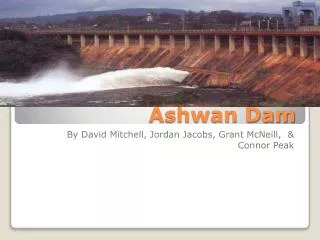
The Aswan High Dam, completed in 1970 by Soviet engineers, controls the Nile River's floods and provides immense hydroelectric power, generating over 10 billion kilowatt-hours annually. While it was a response to Egypt's droughts and famine, its construction required the relocation of 90,000 people and has disrupted the natural silt fertilization of farmland, pushing farmers to rely on artificial fertilizers. The dam, known as Saaed el Aali in Arabic, represents a significant engineering achievement but also highlights the complexities of water resource management.

Ashwan Dam
E N D
Presentation Transcript
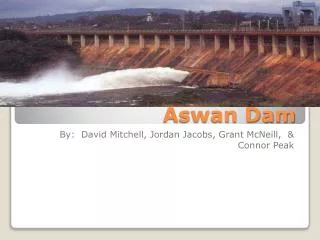
Ashwan Dam By David Mitchell, Jordan Jacobs, Grant McNeill, & Connor Peak
It is located North of the Egyptian-Sudanese border. • Completed in 1970 after 10 years of work by Soviet engineers. • Known as Saaed el Aali in Arabic
Purpose of the Aswan Dam There were some years when the river did not rise at all, causing widespread drought and famine. In 1952, Egyptian president Gamal Abdal-Nasser pledged to control his country's annual flood with a giant new dam across the Nile River. His plan worked.
The Aswan High Dam captures floodwater during rainy seasons and releases the water during times of drought. The dam also generates enormous amounts of electric power -- more than 10 billion kilowatt-hours every year. Pros of the Aswan Dam
In order to build the dam, 90,000 Egyptian people had to move. • To make matters worse, the rich silt that normally fertilized the dry desert land during annual floods was stuck at the bottom of Lake Nasser. • Farmers have been forced to use about one million tons of artificial fertilizer as a substitute for natural nutrients that once fertilized the arid floodplain. Cons of the Aswan dam