Exploring Linguistics: Phonetics, Speech Technology, and Cognitive Communication
30 likes | 179 Vues
Mark Liberman is a faculty member in the Linguistics department at the University of Pennsylvania, where he has contributed since 1990. With a PhD from MIT and extensive research experience at AT&T Bell Labs, he focuses on phonetics, prosody, speech technology, and computational linguistics. His diverse research examines speech patterns, tone, intonation in various languages including West African languages, and the complexities of human communication. As the director of the Linguistic Data Consortium, he actively engages in advancing data-driven linguistic research and enhancing multilingual information retrieval.


Exploring Linguistics: Phonetics, Speech Technology, and Cognitive Communication
E N D
Presentation Transcript
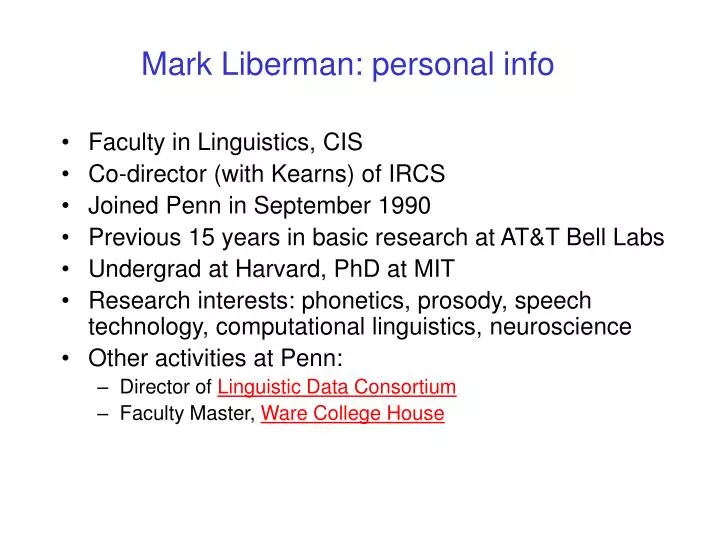
Mark Liberman: personal info • Faculty in Linguistics, CIS • Co-director (with Kearns) of IRCS • Joined Penn in September 1990 • Previous 15 years in basic research at AT&T Bell Labs • Undergrad at Harvard, PhD at MIT • Research interests: phonetics, prosody, speech technology, computational linguistics, neuroscience • Other activities at Penn: • Director of Linguistic Data Consortium • Faculty Master, Ware College House
More on ML’s research • Tone and intonation in speech • West African languages (Yoruba, Igbo, Mawu) • English • Informational focus and its role in discourse • Syntax, morphology • Intonation • Finding information in masses of text and speech • Multilingual information retrieval • Information extraction from biomedical text • Organization of spoken communication in the brain • In humans and other animals today • In hominid evolution • Agent-based models of language evolution and learning
Phonetics and cognition • Phonetics: the sciences of speech sounds and their relation tolinguistic form and meaning • The interface between signals and symbols • Physics and physiology of speech production and perception • The meanings of speech sounds • as a method for expressing words and sentences • as a medium of expression beyond words, for conveying • individual and group identity • structures of information and interaction • emotion and attitude • Communicating with variable signals in noisy environments • General relations between expectation and observation in perception • Temporally complex actions with many simultaneous goals • “Theory of mind”: acting to affect others’ knowledge/belief/emotion • Learning the sound structure of language