Download
1 / 22
230 likes | 348 Vues
Explore the fascinating world of stars and the immense distances within our solar system. Our closest star, the Sun, is just a tiny part of a vast cosmos measured in light years. With light traveling approximately 300,000 km per second, a light year equals about 10 trillion km. Discover what defines a star, the differences between giants and dwarfs, and the life cycles of stars, from yellow dwarfs like our Sun to cataclysmic events like supernovae and the formation of neutron stars and black holes. Learn about galaxies, star clusters, and the energy production of our Sun through nuclear fusion.

E N D
DISTANCES IN THE SOLAR SYSTEM • Our Sun is the closest star to us. • Distances in the solar system are so big that we use a large unit of measurement. • A LIGHT YEAR is the distance light travels in one year.
WHAT IS A LIGHT YEAR? Consider the following: • Light travels 300 000 km every second. • There are 31 536 000 seconds in a year Distance = speed x time • Therefore, if we multiply the numbers together, we get 10 trillion km, or 10 000 000 000 000 km!
LIGHT YEARS, CONT’D • The closest star to us, Alpha Centauri A , is 4.3 light years away. • This is equivalent to 43 000 000 000 000 km away from us!
WHAT IS A STAR? STAR: A collection of matter that emits huge amounts of energy. STARS are classified based on four characteristics: • Colour • Temperature • Size • Brightness
Stars glow because they are very hot. The colour that an object glows tells us how hot it is. Cool stars glow red; very hot stars glow blue. COLOUR & TEMPERATURE
SIZE OF STARS GIANTS AND DWARFS • When a star begins to reach “old age” the pressure inside runs out as all the hydrogen runs out. • As the star gets older, it swells in size. • Our Sun will become a Red Giant as it runs out of fuel. • When it “dies” it will become a white dwarf. • Our Sun is bigger than 95% of the stars in the Universe. • The Size Of Our World
OTHER ASTRONOMICAL STUFF… SUPERNOVA • An enormous explosion when a large star dies. • When all the hydrogen is used up the core collapses • The absence of pressure causes a neutron star or a black hole. • The explosion can be bright enough to see during the day!
OTHER ASTRONOMICAL STUFF… NEUTRON STAR • These stars are ten times bigger than our Sun. • It become a dense core of neutrons. • A PULSAR is a type of neutron star.
OTHER ASTRONOMICAL STUFF… BLACK HOLE • These are stars thirty times bigger than our Sun. • Small, very dense object with an extremely strong gravitational pull. • Nothing can escape from it; not even light.
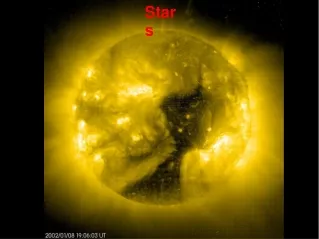
OUR SUN • The Sun’s energy comes from NUCLEAR FUSION, a reaction that takes place under high temperature and pressure. • Nuclear Fusion
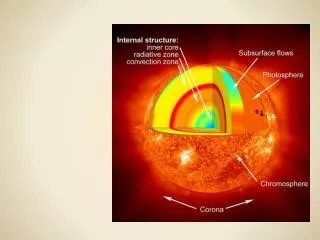
OUR SUN The Sun has multiple layers: • Core:Nuclear fusion takes place here, and temperatures can reach 15 million °C. • Photosphere:The surface of the Sun, made up of moving gases; average temperature of 5500 °C. Sunspots occur here.
OUR SUN • Chromosphere:the inner atmosphere of the Sun • Corona: The hot outer layer of the Sun; temperatures reach 1 million °C.
OUR SUN Other features of the Sun: • Solar Prominence:an explosion of glowing gases from the chromosphere that can last for weeks and reach 40,000 km high. • Solar Flare: Like a solar prominence, but the gases travel into the corona, and last only a few minutes.
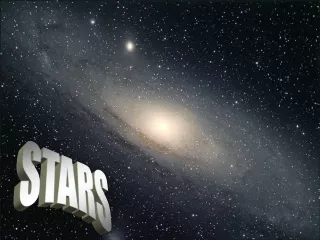
GALAXIES & STAR CLUSTERS • Galaxy: a collection of gas, dust, and hundreds of billions of stars. • Our Sun is located in the less-populated spiral arm of the Milky Way.
GALAXIES & STAR CLUSTERS • There are approximately 400 billion stars in our galaxy. • The majority of the stars are located in the central bulge.
Unusual Galaxies • Quasars:Astronomical objects that look like very faint stars, but emit hundreds of times more energy than entire galaxies. • Scientists do not know the reason for the intense light output.
STAR CLUSTERS • Star Clusters:groups of stars that are close together and travel as a group (as few as 10 or as many as 1 million). Ex. Pleiades