The Endocrine System
PART 1. The Endocrine System. The Endocrine System: An Overview. A system of ductless glands Secrete messenger molecules called hormones Interacts closely with the nervous system Endocrinology Study of hormones and endocrine glands. Endocrine Organs. Scattered throughout the body

The Endocrine System
E N D
Presentation Transcript
PART 1 The Endocrine System
The Endocrine System: An Overview • A system of ductless glands • Secrete messenger molecules called hormones • Interacts closely with the nervous system • Endocrinology • Study of hormones and endocrine glands
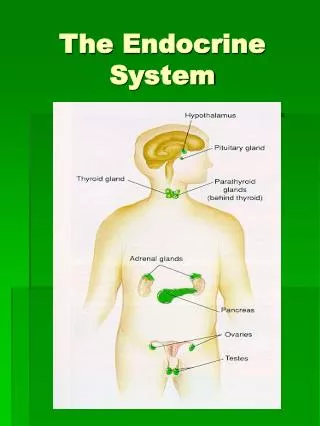
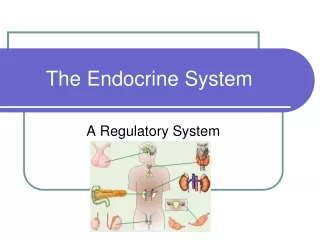
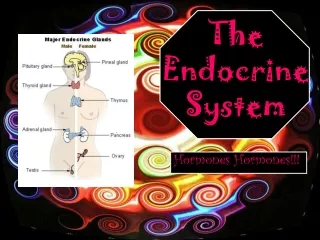
Endocrine Organs • Scattered throughout the body • Pure endocrine organs • Pituitary, pineal, thyroid, parathyroid, and adrenal glands • Organs containing endocrine cells • Pancreas, thymus, gonads, and the hypothalamus • Richly vascularized
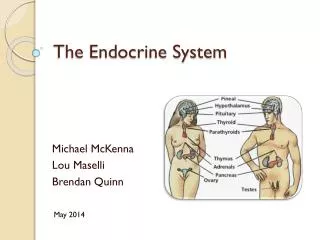
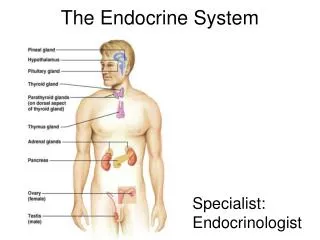
Location of the Major Endocrine Glands Figure 25.1
Hormones • Classes of hormones • Amino acid-based hormones • Steroids – derived from cholesterol • Basic hormone action • Circulate throughout the body in blood vessels • Influences only specific tissues – target cells • A hormone can have different effects on different target cells
Control of Hormones Secretion • Secretion triggered by three major types of stimuli • Humoral – simplest of endocrine control mechanisms • Secretion in direct response to changing ion or nutrient levels in the blood • Parathyroid monitors calcium • Responds to decline by secreting hormone to reverse decline
Control of Hormones Secretion • Neural • Sympathetic nerve fibers stimulate cells in the adrenal medulla • Induces release of epinephrine and norepinephrine • Hormonal • Stimuli received from other glands • Certain hormones signal secretion of other hormones • Hypothalamus secretes hormones stimulates pituitary stimulates other glands
Control of Hormones Release: Three Mechanisms Figure 25.2a–c
Control of Hormones Secretion • Always controlled by feedback loops • Blood concentration declines below a minimum • More hormone is secreted • Blood concentration exceeds maximum • Hormone production is halted
The Pituitary Gland (Hypophysis) • Secretes nine major hormones • Attached to the hypothalamus by the infundibulum • Two basic divisions of the pituitary gland • Adenohypophysis • Neurohypophysis
The Pituitary Gland Figure 25.3a–c
The Adenhypophysis • Pars distalis • The largest division of the adenohypophysis • Contains five different types of endocrine cells • Somatotropic cells • Secrete growth hormone (GH) • Mammotropic cells • Secrete prolactin (PRL)
The Adenhypophysis • Pars distalis endocrine cells (continued) • Thyrotropic cells • Secrete thyroid-stimulating hormone (TSH) • Corticotropic cells • Secrete adrenocorticotropic hormone (ACTH) and melanocyte-stimulating hormone (MSH) • Gonadotropic cells • Secrete follicle-stimulating hormone (FSH) and luteinizing hormone (LH)
The Paris Distalis • Tropic hormones • TSH, ACTH, FSH, and LH • Regulate the secretion of hormones by other endocrine glands • The five endocrine cell types group into three categories when stained • Acidophils • Basophils • Chromophobes
Hypothalamic Control of Hormone Secretionfrom the Adenohypophysis • Hypothalamus • Regulates secretion of hormones • Secretes releasing factors to release hormones • Secretes inhibiting hormones to turn off secretion of hormones
Hypothalamic Control of Hormone Secretionfrom the Adenohypophysis Figure 25.4
The Neurohypophysis • Structurally part of the brain • Secretes two hormones • Antidiuretic hormone (ADH) • Oxytocin Figure 25.5
The Thyroid Gland • Located in the anterior neck • Largest pure endocrine gland • Composed of follicles and areolar connective tissue • Produces two hormones • Thyroid hormone (TH) • Calcitonin
The Thyroid Gland Figure 25.6a
The Thyroid Gland Figure 25.6b, c