Download

1 / 12
120 likes | 235 Vues
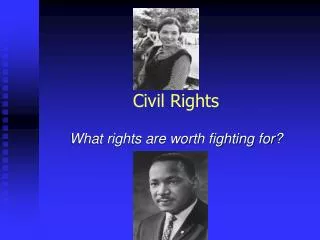
The Civil Rights Movement in the United States was marked by pivotal events and figures advocating for racial equality. From the landmark 1896 Supreme Court decision in Plessy v. Ferguson, which enforced segregation under "separate but equal," to the NAACP's legal battles culminating in Brown v. Board (1954), which overturned Plessy. Iconic moments include the Montgomery Bus Boycott, where Rosa Parks' defiance sparked mass protests led by Martin Luther King Jr., and the tumultuous integration of schools like Central High in Little Rock. Key protests, such as the Birmingham demonstrations and Selma marches, galvanized public support, leading to significant legislation like the Civil Rights Act of 1964 and the Voting Rights Act of 1965.

E N D
Background • Plessy vs. Ferguson – 1896 • Supreme Court allows segregation • Must be “separate but equal” • Schools, restaurants, buses, bathrooms, etc. • De Facto Segregation • “By circumstance” – i.e. neighborhoods • De Jure Segregation • “By law” – i.e. Jim Crow Laws • Discriminate and segregate because of race • NAACP • Seeks equality through courts / legal system
Brown v. Board (1954) • Overturns Plessy v. Ferguson • Thurgood Marshall – NAACP attorney • “Separate is inherently unequal” • Calls for integration of schools • Not popular in South
Montgomery Bus Boycott (1955) • Rosa Parks arrested for not giving up her seat to white man • SCLC leads bus boycott (nonviolent protest) Martin Luther King Jr. emerges as leader • Boycott is successful as bus segregation laws are ended
Little Rock 9 (1957) • 9 black students integrate Central High School in Little Rock AR • Governor orders National Guard to block students’ entry • Rioting, chaos with opposition to integration • President Eisenhower calls in Army to force integration and protect students
Sit-In Movement • Originally sponsored by CORE • Goal was to go into segregated business, usually a restaurant and take a seat that was reserved only for whites • Stay in seat until served or arrested • Must put up with violence • Example of nonviolent protest
Freedom Rides • Designed to test compliance with anti-segregation laws • Bus trips to South, testing integrated bus terminals • Often encountered violence
Birmingham (1963) • Anti-segregation and anti-discrimination demonstrations • Eugene “Bull” Connor – police chief • Connor uses police dogs and fire hoses on demonstrators • Televised, public outraged • Generates support for Civil Rights movement
March on Washington (1963) • In support of Civil Rights Bill in Congress • MLK makes “I Have a Dream” speech • Civil Rights Act of 1964 passed • Segregation is illegal in public places • Bans job discrimination
Selma March (1965) • March from Selma to Montgomery • Increase support for Voting Rights • State police break up march with violence • Televised, public outraged • March is successful on 2nd attempt • Voting Rights Act of 1965 • Helps register unregistered voters • Ends Voting Tests
Alternative movements • Black Power • Means different things to different people • Self-control, pride, self-defense, use violence if necessary • Young people want a more aggressive approach • Some advocate racial separation • Nation of Islam (Black Muslims) • Believe in concept of Black Nationalism • Racial separation, self-government • Malcolm X – Influential member / leader • Originally preaches against MLK and non-violence • Has a change of heart, supports MLK and non-violent movement • Assassinated by Nation of Islam members • Black Panthers • Militant Black Power movement • Use violence to gain equal rights
Martin Luther King’s Assassination • Assassinated – 1968 • James Earl Ray • In Memphis