Extragalactic HI Surveys: Investigating the Local Universe's Dark and Luminous Matter Distribution
280 likes | 415 Vues
This research project focuses on extragalactic HI surveys aimed at understanding fundamental components of the local universe, including the faint end of the HI mass function (HIMF), local density dependence, and distribution of both luminous and dark matter at distances less than 0.1 redshift. The goals include assessing gas-rich galaxy group memberships, exploring rare OH megamasers, and modelling probability detections concerning signal-to-noise ratios. The findings will enhance our understanding of cosmic structures and contribute to astronomical survey methodologies.


Extragalactic HI Surveys: Investigating the Local Universe's Dark and Luminous Matter Distribution
E N D
Presentation Transcript
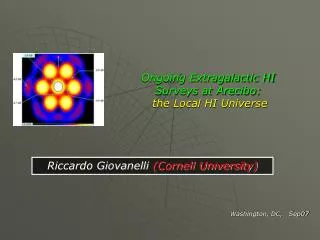
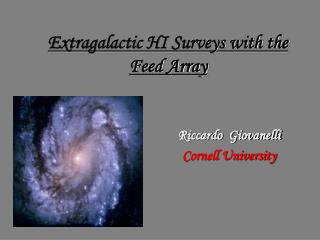
Extragalactic HI Surveys with the Feed Array Riccardo Giovanelli Cornell University
Main Scientific Goals: • Investigate the faint end of the HI mass function • (HIMF) • Determine the local density dependence of the HIMF • Map the distribution of luminous and dark matter • in the local (z < 0.1) Universe • Determine the gas-rich membership of nearby • groups of galaxies • Determine the population of gas-rich systems in the • Local Group and the periphery of the MW (HVCs) • Find (rare) OH Megamasers near z=0.25 • Be surprised
Beam dilution [by comparison, HIPASS detects 1 million solar masses at 1 Mpc in 460 sec…]
HIMF where Zwaan et al. 97: Rosenberg & Schneider 02: [Mpc**-3 dex**-1]
Source-to-beam extent Integration time in sec Signal width in km/s
The reliability of a detection depends on S/N. • Model the probability p, that a “detection” at given S/N • will be confirmed, as • Model W_kms as Gauss deviate with dispersion 0.1 dex about scramble disk inclination and add turbulent term • Model source size as
Simulate random pointing errors and estimate • beam dilution factor • Model suppression of gas infall onto low mass • halos due to reionization (e.g. adopting the • “filtering mass” criterion of Gnedin & Hui 1998) Next, adopt a model for the cosmic density field
Slice of the cosmic Density field along The Supergalactic Plane You are here
Where are the Low HI mass Systems? Normalized Cosmic Density • Most of the mass is to be found in regions of density • substantially higher than average Caveat: But, do low baryonic mass systems trace the cosmic density distribution?
A set of survey simulations: • All-AO, fast (6-sec) sky survey: • ALFALFA • 300 - sec ZOA ``staring’’ survey • ZOA • 60 - sec Virgo Cluster survey • VIRGO
ZOA 300 sec |b| < 10 AO limits
ZOA 300 sec |b| < 10 AO limits
ZOA 300 sec |b| < 10 AO limits
Virgo 11h-13h RA 0 to 27 Dec 60 sec 800 hours
1 second 1 second
[by comparison, HIPASS detects 1 million solar masses at 1 Mpc in 460 sec…]