Download
1 / 8
80 likes | 199 Vues
This resource provides an in-depth look at the Legislative Branch of the United States government, focusing on bicameralism. It includes a worksheet on Article 1, a review of the reasons for a bicameral legislature, and a comparison of the Senate and House of Representatives. The content covers historical, practical, and theoretical perspectives on bicameralism, the composition of both houses, and their roles in checking powers. Additionally, the document outlines test corrections to enhance understanding of these key concepts.

E N D
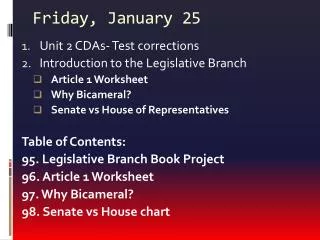
Friday, January 25 • Unit 2 CDAs- Test corrections • Introduction to the Legislative Branch • Article 1 Worksheet • Why Bicameral? • Senate vs House of Representatives Table of Contents: 95. Legislative Branch Book Project 96. Article 1 Worksheet 97. Why Bicameral? 98. Senate vs House chart
Test Corrections • Grade your test, mark all incorrect answers. • For each incorrect answer: • Question Number • Your Answer • Correct Answer • Question and Answer written in a sentence.
3 Reasons: • Historical Reasons • Practical Reasons • Theoretical Reasons
Historical • The British Parliament had 2 houses since the 1300s • Most of the colonies had bicameral assemblies already They were used to bicameralism!
Practical • The Framers had to create a bicameral legislature to settle the arguments between the New Jersey plan and Virginia plan • They wanted to keep the peace and make everyone happy!
Theoretical • The Framers wanted the two houses (Senate and House of Representatives) to be able to check each other • The Framers wanted to keep Congress from becoming super powerful and taking control of the other two branches. • They wanted to split the power of Congress!
House of Reps Senate • lower house • more representative of the people • 435 members • Each state has a number based on their population • One representative per district represent their district • 25 years old • 2 year term • Leader is Speaker of the House • Upper house • Originally chosen by State, after 17th Amendment- chosen by voters • 100 members- 2 per state • Represent the whole state • 30 years old • 6 year term • Leader is the President of the Senate (VP of the country) and President Pro Tempore