Download
1 / 11
110 likes | 215 Vues
This presentation highlights the challenges in the Early Hearing Detection and Intervention (EHDI) systems, focusing on the prevalence and identification of children with minimal hearing loss. Using data from the 2003 DSHPSHWA survey, it presents alarming statistics about missed cases, particularly involving mild and unilateral hearing loss. Factors contributing to this issue, such as technology limitations, lack of follow-up, and emphasis on lowering referral rates, are discussed. Recommendations to improve EHDI systems, including ongoing screening and targeted prevalence studies in preschool years, are also emphasized.

E N D
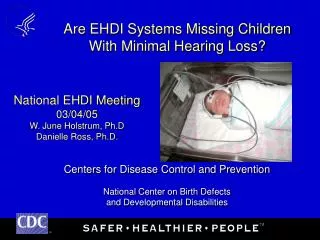
Are EHDI Systems Missing Children With Minimal Hearing Loss? National EHDI Meeting 03/04/05 W. June Holstrum, Ph.D Danielle Ross, Ph.D.
Difference in Prevalence Estimates • Study population • Age of subjects • Sample size • Method of sampling • Population based/Clinical sample • Based on records/interviews/audiological tests • Definitions of hearing loss • Laterality (best/worse ear) • Frequency • dB Threshold
Possible Explanations for Change is Prevalence (From birth to School Age) • Progressive or late onset • Infections/illnesses, e.g. OME • Trauma • Noise • EHDI system misses
DSHPSHWA Data • Y2003 DSHPSHWA Survey • Data from 27 states • Number born = 1,503,627 • Number Screened = 1,457,639 (96%) • Number Identified = 1,646 (1.1/1000) • Number categorized = 1,252 • 826 Bilateral (66%) • 426 Unilateral (34%) • % Lost to System = 42% (0 – 90%)
Hearing Loss by CategoryUnilateral = 34% Bilateral = 66% Data from Y2003 DSHPSHWA Survey (27 States Reporting)
Mild Unilateral Hearing Loss by State(33% of all Unilateral were Mild)
Mild Bilateral Hearing Loss by State(28% of all Bilateral were Mild)
Possible Explanationsfor Missing Infants with Minimal HL • Technology • Screeners • Lack of interest in minimal hearing loss • Lost to the system • Lack of follow-up of high-risk infants • Emphasis on lowering referral rates
Conclusions(Too many misses - Need more home runs) • Babies with mild and unilateral losses are being missed. • Improve EHDI Systems to • Identity desired level of loss • Reduce lost to the system • Screening needs to be on-going • Need prevalence studies on HL in preschool years.