Exploring Human and Animal Hair as Class Evidence in Forensics
Chapter 5 delves into the significance of hair in forensic science, underscoring its role as class evidence to support circumstantial evidence. Hair absorbs substances from the body and environment, aligning with the Locard Exchange Principle, which posits a cross-transfer of evidence. It discusses the structure of hair, comprising the cuticle, cortex, and medulla, and highlights the differences between human and animal hair. Furthermore, it outlines the growth stages of human hair, the average diameter, and the classification importance of hair roots.

Exploring Human and Animal Hair as Class Evidence in Forensics
E N D
Presentation Transcript
Chapter Learning Objectives • Hair is class evidence. • Hair can be used to back up curcumstantial evidence. • Hair absorbs substances within the body and from the external environment.
Locard Exchange Principle • Hair is considered class evidence and is useful in backing up circumstantial evidence. • Locard Exchange Principle states there is always a cross transfer of evidence between suspect and victim
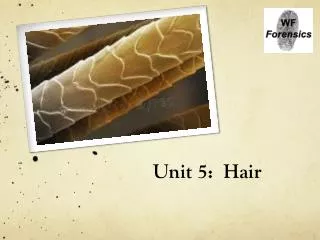
Human Hair • Hair is made up of protein polymers. • The hair shaft is composed of 3 parts – the cuticle (outer), the cortex (middle), and the medulla (core). • The cortex is made of keratin.
Animal hairs • Animal hairs show a wide variety of medullar patterns
Human hair growth • The diameter of human hair is 25-125 um. • Human hair grows about 1 cm per month. • The root can be important in classifying hair. • The 3 stages of growth are; • Anagen phase – averages 3-5 years • Catagen phase – intermediate phase lasting 3 weeks • Telogen phase – final phase of growth