Understanding the Spanish "Se" Construction: Exploring Impersonal Expressions
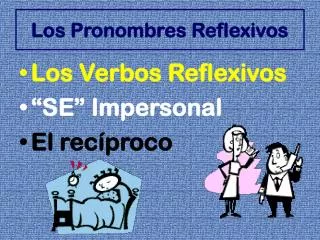
The Spanish word "se" plays a vital role in creating impersonal sentences. It translates to expressions like "We speak Spanish" or "One speaks Spanish," but lacks a direct English equivalent. This construction is often used when the subject is not essential, similar to how we avoid using "you" in formal English writing. For instance, Spanish sentences like "Cuando se llega a Oklahoma" and "Se come bien en la casa de mi mamá" emphasize actions rather than specific people. Understanding this concept enhances your Spanish fluency.


Understanding the Spanish "Se" Construction: Exploring Impersonal Expressions
E N D
Presentation Transcript
Ever seen a sign that says, Se habla español. What does that mean? It can be translated, “We speak Spanish,” “Spanish is spoken,” “One speaks Spanish,” etc. The truth is that there’s not a literal translation for it.
“Se” can be used when the subject of the sentence really isn’t important. Have you ever used “you” in an English paper and had your teacher tell you that you can’t use “you”? Something like “The drive to California is a killer. When you get to Oklahoma . . .” You don’t really mean “when YOU get to Oklahoma.” You probably change your paper to read “when one gets to Oklahoma.” In Spanish, you’d say, “Cuando se llega a Oklahoma.” We don’t really mean you or me or anyone in particular. The subject really isn’t important.
What about this: I can’t wait to go home. You eat really well at my mom’s house. Obviously, “you” doesn’t mean anyone in particular. In Spanish it would be Se come bien en la casa de mi mamá. The idea is that the eating is good there.
One note: the verb is ALWAYS third person, but sometimes it is third person plural. Technically, there’s no subject in the sentence, but the tendency is to grab the closest noun and make the verb agree with it: Se comen hamburguesas en McDonald’s. You eat hamburgers at McDonald’s. or One eats hamburgers at McDonald’s. or Hamburgers are what’s served at McDonald’s. You use “comen” rather than “come” because “hamburguesas” is plural.
Click here to go to a brief practice exercise. Click here and here to go to your homework. (2 exercises)