The New Unionism: A Radical Shift in Labor Movements and Industrial Strikes (1909-1916)
This overview explores the emergence of "New Unionism" from 1909 to 1916, highlighting radical unions like the IWW and garment workers' organizations. It examines industrial strikes across key sectors including steel, textiles, and garments, and analyzes the factors influencing their outcomes, including union organization, public opinion, and employer responses. The movement drew in diverse workers such as immigrants, women, and semi-skilled workers, radically altering labor dynamics in America. The impact of institutionalism and syndicalism in shaping labor relations is also discussed.

The New Unionism: A Radical Shift in Labor Movements and Industrial Strikes (1909-1916)
E N D
Presentation Transcript
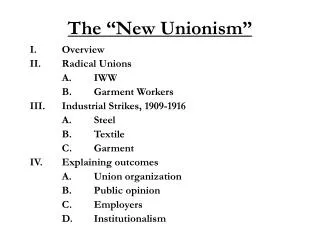
The “New Unionism” I. Overview II. Radical Unions A. IWW B. Garment Workers III. Industrial Strikes, 1909-1916 A. Steel B. Textile C. Garment IV. Explaining outcomes A. Union organization B. Public opinion C. Employers D. Institutionalism
Overview • Workers • Immigrants, blacks, & women • Jobs • Semi-skilled factory labor • Units • Industrial unions Striking laundry workers, Chicago, 1903
IWW • Western Federation of Miners • IWW founded 1905 as response to AFL • Syndicalism WFM leaders, Pettibone, Haywood, and Moyer, on trial, 1907
Garment Workers • Workers • Immigrants • Eastern European Jews • Lithuanians • Italians • Women • Unions • International Ladies Garment Workers • United Garment Workers
Steel Members of PA constabulary, 1909 “Bloody corner” McKee Rocks, PA, 1909 ↓
Textile • Lawrence • Lowell • Patterson
Clothing • 1909 • 20K shirtwaist workers • 1910 • 60K NYC cloak-makers • 40K in Chicago • 1911 • 150K workers Rochester, 1913
Organization Garment workers: • Avoid factionalism • Amalgamated • Retain ties to AFL establishment Chicago garment workers in Labor Day parade, 1915
Public Opinion • Machismo v. Maternalism • Radical Chic v. Middle-class Morality • Triangle Fire, 1911
Employers • Garment manufacturers and retailers were often German Jews • Heavily involved in reform movements • Connection to workers creates sense of responsibility Edward A. Filene
Institutionalism • IWW Syndicalism versus • ACWA Brandeis-ism ACWA members thank leader Sidney Hillman, 1915