Download
1 / 1
10 likes | 121 Vues
Discover the Cosmos offers tools and services for astronomers and physicists, including robotic telescopes, image processing software, and access to educational content. Explore free resources for astrophotography, astronomical data analysis, and more. Access stellarium and salsaJ for virtual planetarium and image editing. Dive into high-energy physics with Hypatia and Discovery Space. Utilize over 80,000 digital resources on astronomy, physics, and math through the Cosmos Portal. Engage with mobile learning applications and blended courses on CERN projects. Discover sustainable projects for science teaching and learning with COSMOS and Learning with ATLAS@CERN.

E N D
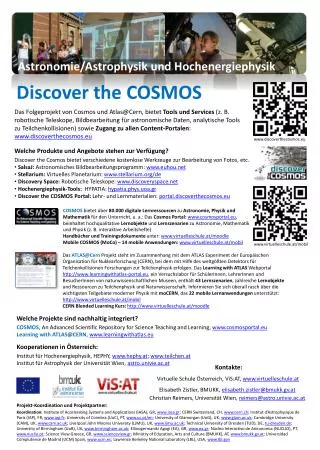
Astronomie/Astrophysik und Hochenergiephysik Discoverthe COSMOS Das Folgeprojekt von Cosmos und Atlas@Cern, bietet Tools und Services (z. B. robotische Teleskope, Bildbearbeitung für astronomische Daten, analytische Tools zu Teilchenkollisionen) sowie Zugang zu allen Content-Portalen: www.discoverthecosmos.eu www.discoverthecosmos.eu • Welche Produkte und Angebote stehen zur Verfügung? • DiscovertheCosmos bietet verschiedene kostenlose Werkzeuge zur Bearbeitung von Fotos, etc. • SalsaJ: Astronomisches Bildbearbeitungsprogramm: www.euhou.net • Stellarium: Virtuelles Planetarium: www.stellarium.org/de • Discovery Space:RobotischeTeleskope: www.discoveryspace.net • Hochenergiephysik-Tools: HYPATIA: hypatia.phys.uoa.gr • Discoverthe COSMOS Portal: Lehr- und Lernmaterialien: portal.discoverthecosmos.eu COSMOSbietet über 80.000 digitale Lernressourcen zu Astronomie, Physik und Mathematik für den Unterricht, u. a.: DasCosmos Portal:www.cosmosportal.eu, beinhaltet hochqualitative Lernobjekte und Lernszenarien zu Astronomie, Mathematik und Physik (z. B. interaktive Arbeitshefte) Handbücher und Trainingsdokumente unter: www.virtuelleschule.at/moodle Mobile COSMOS (MoCo) – 14 mobile Anwendungen: www.virtuelleschule.at/mobil www.virtuelleschule.at/mobil Das ATLAS@Cern Projektsteht im Zusammenhang mit dem ATLAS Experiment der Europäischen Organisation für Nuklearforschung (CERN), bei dem mit Hilfe des weltgößten Detektors für Teilchenkollisionen Forschungen zur Teilchenphysik erfolgen. Das Learning with ATLAS Webportal http://www.learningwithatlas-portal.eu, ein Versuchslabor für SchülerInnen, LehrerInnen und BesucherInnen von naturwissenschaftlichen Museen, enthält 43 Lernszenarien, zahlreiche Lernobjekte und Ressourcen zu Teilchenphysik und Naturwissenschaft. Informieren Sie sich überall rasch über die wichtigsten Teilgebiete moderner Physik mit moCERN, das 22 mobile Lernanwendungen unterstützt: http://www.virtuelleschule.at/mobil CERN Blended Learning Kurs: http://www.virtuelleschule.at/moodle Welche Projekte sind nachhaltig integriert? COSMOS, An Advanced Scientific Repository for Science Teaching and Learning, www.cosmosportal.eu Learning with ATLAS@CERN, www.learningwithatlas.eu Kooperationen in Österreich: Institut für Hochenergiephysik, HEPHY, www.hephy.at; www.teilchen.at Institut für Astrophysik der Universität Wien, astro.univie.ac.at Kontakte: Virtuelle Schule Österreich, ViS:AT, www.virtuelleschule.at Elisabeth Zistler, BMUKK, elisabeth.zistler@bmukk.gv.at Christian Reimers, Universität Wien, reimers@astro.univie.ac.at Projekt-Koordination und Projektpartner: Koordination: Institute ofAccelerating Systems andApplications (IASA), GR, www.iasa.gr; CERN Switzerland, CH, www.cern.ch; Institut d’Astrophysique de Paris (IAP), FR, www.iap.fr; University ofCoimbra (UoC), PT, www.uc.pt/en; University ofGlamorgan (UoG), UK, www.glam.ac.uk; Cambridge University (CAM), UK, www.cam.ac.uk; Liverpool John Moores University (LJMU), UK, www.ljmu.ac.uk; Technical University of Dresden (TUD), DE, tu-dresden.de; University of Birmingham (UoB), UK, www.birmingham.ac.uk; EllinogermanikiAgogi (EA), GR, www.ea.gr; NúcleoInteractivo de Astronomia (NUCLIO), PT, www.nuclio.pt; Science View Greece, GR, www.scienceview.gr; Ministryof Education, Artsand Culture (BMUKK), AT, www.bmukk.gv.at; UniversidadComplutense de Madrid (UCM) Spain, www.ucm.es; Lawrence Berkeley National Laboratory (LBL), USA, www.lbl.gov