Solar System Notes
This guide explains the two primary ways Earth moves: rotation and revolution. It details how Earth's axial tilt of 23.5 degrees influences seasonal changes, with the North and South poles alternating points towards the Sun. Newton's Universal Law of Gravitation is outlined, explaining how gravity attracts all objects based on mass and distance. The document also covers the phases of the Moon, eclipses, tides, and the specifics of the inner and outer planets in our solar system. Ideal for educational presentations on astronomy.

Solar System Notes
E N D
Presentation Transcript
Earth moves in two ways • Rotation – spinning on an axis • Revolution – one object moving around another
Seasons on Earth • Earth tilted 23.5o • ½ the year, North is pointed to the Sun, peaking in June solstice. • ½ the year, South is pointed to the Sun, peaking in December solstice. • March (Spring) and Sept. (Fall) Equinox: neither pole is leaning to sun
Newton’s Universal Law of Gravitation • States every object in the universe attracts every other object • Force of gravity measured in newtons • Strength of gravity depends on 2 factors: • Masses of the objects • Distance between them
Phases of the moon • Changing relative positions of the moon, Earth, and sun cause them • The visible phase of the moon depends on how much of the sunlit side faces Earth
Eclipses • When the moon’s shadow hits Earth or Earth’s shadow hits the moon, an eclipse occurs • Solar eclipse: moon is between Earth and the sun • Lunar eclipse: Earth is between the moon and the sun
Tides • Tides are caused by the moon’s gravity pulling on different parts of Earth (pulling the sea level up) • Spring tides: sun and moon are lined up, causing highest high and lowest low tides • Neap tides: sun and moon at right angle to Earth, causing least difference between tides
The Moon • Dry, airless, with highly varied surface temps • Temp. range: -180o – 130o C because it has NO atmosphere • Diameter approx equal to distance across USA • Collision ring theory: a planet-sized object collided with Earth to form the moon
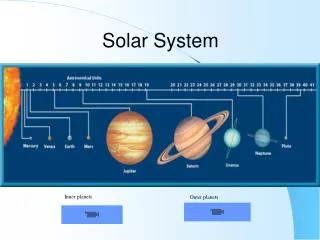
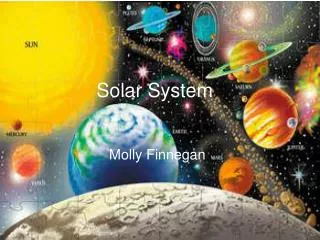
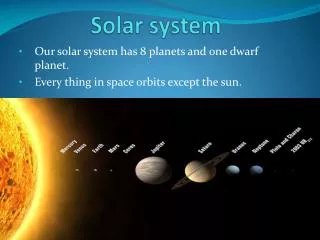
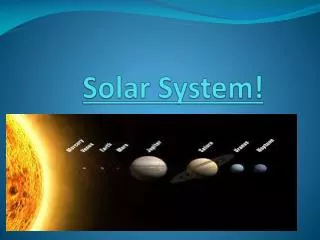
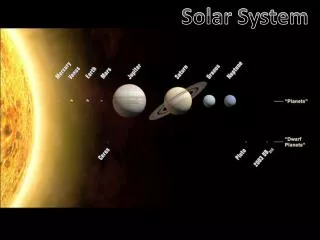
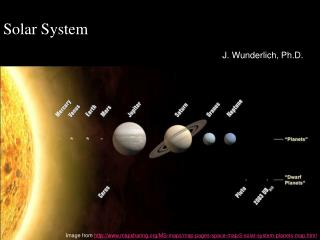
Our Solar System Inner Planets • Sun*, Mercury, Venus, Earth, Mars • Jupiter, Saturn, Uranus, Neptune, Pluto* Outer Planets
Solar System Powerpoint • Copy guidelines on separate sheet of paper • Groups 3-4 (3 preferred) • Select a member of our Solar System and get approval by Mr. Ladwig (1st come, 1st served) • Create Powerpoint to present to class • Include 1 quiz question given to Mr. Ladwig (with answer) • Don’t use images as backgrounds!
PPT Requirements • Size (km): diameter & radius • Period of rotation (Earth days) • Avg. distance from sun (AU) • Period of revolution (Earth years) • # of moons • Atmosphere contents • Planetary structure • Exploration missions • At least 2 images of it • History of its discovery