Understanding Congruent and Vertical Angles in Geometry
In this lesson, you will learn how to identify and utilize congruent and vertical angles. Congruent angles are those that have the same degree measure, while vertical angles are formed when two lines intersect, resulting in two pairs of nonadjacent angles that are congruent. This lesson covers the properties of congruent angles, construction techniques, and relationships among complementary and supplementary angles. Mastering these concepts will enhance your understanding of geometric relationships and help solve practical angle measurement problems.

Understanding Congruent and Vertical Angles in Geometry
E N D
Presentation Transcript
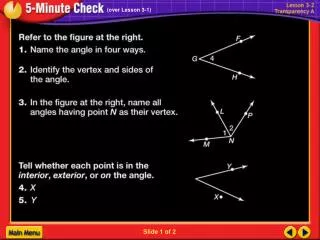
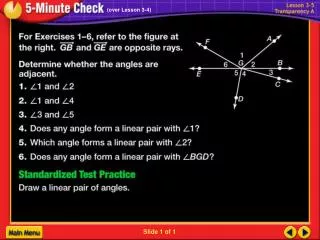
(over Lesson 3-5) 1-1a Slide 1 of 1
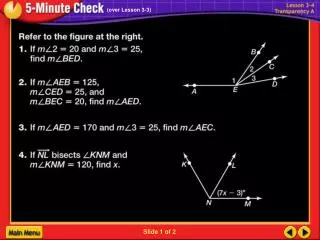
(over Lesson 3-5) 1-1b Slide 1 of 1
§3.6 Congruent Angles What You'll Learn You will learn to identify and use congruent and vertical angles. Recall that congruent segments have the same ________. measure Congruent angles _______________ also have the same measure.
50° 50° B V §3.6 Congruent Angles Two angles are congruent iff, they have the same ______________. degree measure B V iff mB = mV
1 2 X Z §3.6 Congruent Angles arcs To show that 1 is congruent to 2, we use ____. To show that there is a second set of congruent angles, X and Z, we use double arcs. This “arc” notation states that: X Z mX = mZ
§3.6 Congruent Angles four When two lines intersect, ____ angles are formed. There are two pair of nonadjacent angles. vertical angles These pairs are called _____________. 1 4 2 3
§3.6 Congruent Angles Two angles are vertical iff they are two nonadjacent angles formed by a pair of intersecting lines. Vertical angles: 1 and 3 1 4 2 2 and 4 3
1 4 2 3 §3.6 Congruent Angles 1) On a sheet of paper, construct two intersecting lines that are not perpendicular. 2) With a protractor, measure each angle formed. 3) Make a conjecture about vertical angles. Consider: A. 1 is supplementary to 4. m1 + m4 = 180 Hands-On B. 3 is supplementary to 4. m3 + m4 = 180 Therefore, it can be shown that 1 3 Likewise, it can be shown that 24
1 4 2 3 §3.6 Congruent Angles 1) If m1 = 4x + 3 and the m3 = 2x + 11, then find the m3 x = 4; 3 = 19° 2) If m2 = x + 9 and the m3 = 2x + 3, then find the m4 x = 56; 4 = 65° 3) If m2 = 6x - 1 and the m4 = 4x + 17, then find the m3 x = 9; 3 = 127° 4) If m1 = 9x - 7 and the m3 = 6x + 23, then find the m4 x = 10; 4 = 97°
§3.6 Congruent Angles Vertical angles are congruent. n m 2 1 3 3 1 2 4 4
130° x° §3.6 Congruent Angles Find the value of x in the figure: The angles are vertical angles. So, the value of x is 130°.
§3.6 Congruent Angles Find the value of x in the figure: The angles are vertical angles. (x – 10) = 125. (x – 10)° x – 10 = 125. 125° x = 135.
§3.6 Congruent Angles Suppose two angles are congruent. What do you think is true about their complements? 1 2 2 + y = 90 1 + x = 90 y is the complement of 2 x is the complement of 1 y = 90 - 2 x = 90 - 1 Because 1 2, a “substitution” is made. y = 90 - 1 x = 90 - 1 x = y x y If two angles are congruent, their complements are congruent.
60° 60° B A 1 2 3 4 §3.6 Congruent Angles If two angles are congruent, then their complements are _________. congruent The measure of angles complementary to A and B is 30. A B If two angles are congruent, then their supplements are _________. congruent The measure of angles supplementary to 1 and 4 is 110. 110° 110° 70° 70° 4 1
3 1 2 §3.6 Congruent Angles If two angles are complementary to the same angle, then they are _________. congruent 3 is complementary to 4 5 is complementary to 4 4 3 5 5 3 If two angles are supplementary to the same angle, then they are _________. congruent 1 is supplementary to 2 3 is supplementary to 2 1 3
52° 52° A B §3.6 Congruent Angles Suppose A B and mA = 52. Find the measure of an angle that is supplementary to B. 1 B + 1 = 180 1 = 180 – B 1 = 180 – 52 1 = 128°
§3.6 Congruent Angles If 1 is complementary to 3, 2 is complementary to 3, and m3 = 25, What are m1 and m2 ? m1 + m3 = 90 Definition of complementary angles. m1 = 90 - m3 Subtract m3 from both sides. m1 = 90 - 25Substitute 25 in for m3. m1 = 65Simplify the right side. You solve for m2 m2 + m3 = 90 Definition of complementary angles. m2 = 90 - m3 Subtract m3 from both sides. m2 = 90 - 25Substitute 25 in for m3. m2 = 65Simplify the right side.
G D 1 2 A C 4 B 3 E H §3.6 Congruent Angles 1) If m1 = 2x + 3 and the m3 = 3x - 14, then find the m3 x = 17; 3 = 37° 2) If mABD = 4x + 5 and the mDBC = 2x + 1, then find the mEBC x = 29; EBC = 121° 3) If m1 = 4x - 13 and the m3 = 2x + 19, then find the m4 x = 16; 4 = 39° 4) If mEBG = 7x + 11 and the mEBH = 2x + 7, then find the m1 x = 18; 1 = 43°
Suppose you draw two angles that are congruent and supplementary. What is true about the angles?
1 2 C A B §3.6 Congruent Angles If two angles are congruent and supplementary then each is a __________. right angle 1 is supplementary to 2 1 and 2 = 90 All right angles are _________. congruent A B C
B A 2 E 3 1 4 C D §3.6 Congruent Angles If 1 is supplementary to 4, 3 is supplementary to 4, and m 1 = 64, what are m 3 and m 4? They are vertical angles. 1 3 m 1 = m3 m 3 = 64 3 is supplementary to 4 Given Definition of supplementary. m3 + m4 = 180 64 + m4 = 180 m4 = 180 – 64 m4 = 116