Download
1 / 12
120 likes | 250 Vues
In this lesson, you'll explore the Angle Addition Postulate, which states that the sum of the measures of two smaller angles is equal to the measure of a larger angle formed by them. You will learn how to find the measures of angles and their bisectors through examples and engaging activities. By drawing and labeling angles, and applying the postulate, you'll gain a clearer understanding of the relationships between angles. Join us to enhance your geometry skills with practical applications of this fundamental concept!

E N D
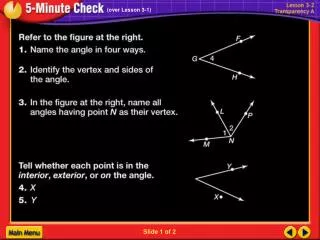
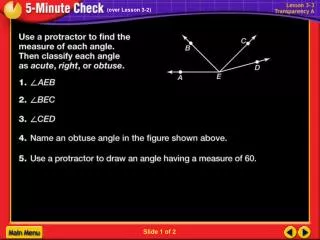
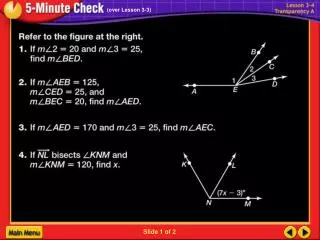
(over Lesson 3-2) 1-1a Slide 1 of 2
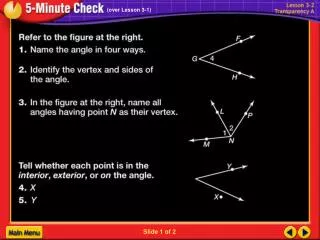
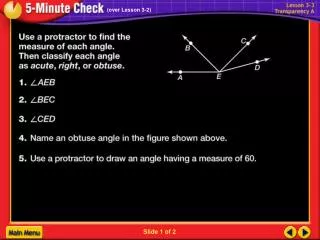
(over Lesson 3-2) 1-1b Slide 1 of 2
Vocabulary §3.3 The Angle Addition Postulate What You'll Learn You will learn to find the measure of an angle and the bisectorof an angle. NOTHING NEW!
R X 2) Draw and label a point X in the interior of the angle. Then draw SX. S T §3.3 The Angle Addition Postulate 1) Draw an acute, an obtuse, or a right angle. Label the angle RST. 45° 75° 30° 3) For each angle, find mRSX, mXST, and RST.
R X S T §3.3 The Angle Addition Postulate 1) How does the sum of mRSX and mXST compare to mRST ? Their sum is equal to the measure of RST . mXST = 30 + mRSX = 45 = mRST = 75 2) Make a conjecture about the relationship between the two smaller angles and the larger angle. 45° The sum of the measures of the twosmaller angles is equal to the measureof the larger angle. The Angle Addition Postulate (Video) 75° 30°
P 1 Q A 2 R §3.3 The Angle Addition Postulate m1 + m2 = mPQR. There are two equations that can be derived using Postulate 3 – 3. m1 = mPQR –m2 These equations are true no matter where A is locatedin the interior of PQR. m2 = mPQR –m1
X 1 Y W 2 Z §3.3 The Angle Addition Postulate Find m2 if mXYZ = 86 and m1 = 22. Postulate 3 – 3. m2 + m1 = mXYZ m2 = mXYZ –m1 m2 = 86 – 22 m2 = 64
C D (5x – 6)° 2x° B A §3.3 The Angle Addition Postulate Find mABC and mCBD if mABD = 120. mABC + mCBD = mABD Postulate 3 – 3. Substitution 2x + (5x – 6) = 120 7x – 6 = 120 Combine like terms 7x = 126 Add 6 to both sides x = 18 Divide each side by 7 36 + 84 = 120 mCBD = 5x – 6 mABC = 2x mCBD = 5(18) – 6 mABC = 2(18) mCBD = 90 – 6 mABC = 36 mCBD = 84
§3.3 The Angle Addition Postulate Just as every segment has a midpoint that bisects the segment, every angle has a ___ that bisects the angle. ray angle bisector This ray is called an ____________ .
is the bisector of PQR. P 1 Q A 2 R §3.3 The Angle Addition Postulate m1 = m2
Since bisects CAN, 1 = 2. N T 2 1 A C §3.3 The Angle Addition Postulate If bisects CAN and mCAN = 130, find 1 and 2. 1 + 2 = CAN Postulate 3 - 3 Replace CAN with 130 1 + 2 = 130 1 + 1 = 130 Replace 2 with 1 2(1) = 130 Combine like terms (1) = 65 Divide each side by 2 Since 1 = 2, 2 = 65