Understanding the Integumentary System and Cell Cycle: Exploring DNA Mechanisms
This resource provides an in-depth exploration of the integumentary system and cell cycle processes critical to understanding genetics and living systems. Students will learn about the structures and functions of DNA and how they contribute to genetic traits. The curriculum covers the phases of the cell cycle, including interphase and mitosis, along with activities such as creating diagrams to illustrate cellular activities. Additionally, the role of nucleotides, DNA replication, and the significance of the integumentary system's renewal process are examined for a comprehensive understanding of life sciences.

Understanding the Integumentary System and Cell Cycle: Exploring DNA Mechanisms
E N D
Presentation Transcript
The Integumentary System More Than Skin Deep Cell Cycle
TAKS • TAKSObjective 2 – The student will demonstrate an understanding of living systems and the environment.
TEKS • The student knows the structures and functions of nucleic acids in the mechanisms of genetics. The student is expected to • describe components of deoxyribonucleic acid (DNA); and illustrate how information fro specifying traits of an organism is carried in the DNA; • explain replication, transcription, and translation using models of DNA and ribonucleic acid
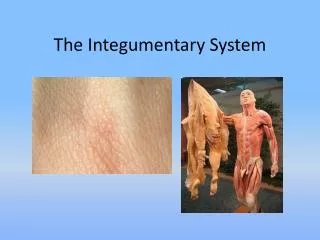
Engage • Humans shed their entire epidermis every 15 to 30 days. • Bloodhounds detect this upon tracking
Explore 1: Cell Cycle Research • Student will complete a cell cycle diagram with detailed description of cellular activity in each of the cell cycle phases.
Explain: Cell Cycle • All cells constantly replace themselves by a process called mitosis, which is a small section of the cell cycle. • New skin cells push the older generation of cells toward the surface of the skin, where they are finally shed as a flake-like, lifeless, residue
M phase (Mitosis) Interphase G1 phase S phase G2 phase Prophase Metaphase Anaphase Telophase What are the two main phases of the cell cycle? Cell Cycle includes is divided into is divided into
The Cell Cycle? • Cell cycle - changes a cell goes through during its life span. • contains 2 main steps. • 1.Interphase (LONGEST phase of the cell cycle and has three parts) • G1 (Everyday Cellular Activity) • S (DNA Synthesis) • G2 (Other Organelles Replicated) • 2. M-Phase or Mitotic Phase (Shortest phase) • Mitosis (Nuclear Division) • Cytokinesis (Cytoplasm Division)
Photo 51 • Scientific contributions to the discovery of the DNA structure.
Review: Interphase (G1) • What is the main purpose of a cell that is in G1? • G1 Phase: During this stage the cell is carrying on its everyday activities. • If the cell’s surface to volume ratio gets too big then the cell must get ready to divide. • Do some cells entering a resting state? • What is this phase called? • G0 Phase: Resting State - Some cells leave the cell cycle and stay here much longer than others ex) brain, nerve, etc…
Purines Pyrimidines Adenine Guanine Cytosine Thymine Phosphate group Deoxyribose Explain: DNA Section 12-1 Nucleotides
Nucleotide Hydrogen bonds Sugar-phosphate backbone Key Adenine (A) Thymine (T) Cytosine (C) Guanine (G) Structure of DNA Section 12-1
DNA • Deoxyribose Sugar • Base Pairs A-T G-C • Phosphate
What is a Nucleotide? The basic building block of nucleic acids containing a sugar, base, and a phosphate. P B S S= Deoxyribose Sugar or Ribose Sugar B = Adenine, Guanine, Cytosine, Thymine or Uracil P = Phosphate
Bases(Nitrogenous Bases) • These chemicals are often called nitrogenous bases because of the high content of nitrogen (N) atoms
Pyrimidines • 1) Cytosine (C) • 2) Thymine (T) • 3) Uracil (U)
Nucleotide • The Sugar and the Phosphate make up the backbone of the structure • The bases make up the rungs of the ladder
Parts of DNA and RNA • Have a Sugar/Phosphate Backbone • Bases make up the steps of the ladder • A-T---DNA • A-U---RNA • G-C---DNA & RNA
Practice • On your paper, complete the missing DNA strand by adding the complementary bases. • A T C G T T G C C A T C • T A G C A A C G G T A G
DNA Replication A Closer Look • DNA before replication: 1 double helix • DNA after replication: 2 identical double helixes
Original strand DNA polymerase New strand Growth DNA polymerase Growth Replication fork Replication fork Nitrogenous bases New strand Original strand DNA Replication Section 12-2
Two New DNA Molecules • Each DNA Molecule with a Parent and Daughter Strand
Interphase (G2) • G2 phase: The rest of the cell’s organelles are reproduced.