Download
1 / 45
450 likes | 574 Vues
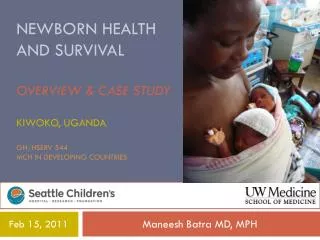
This overview presents the critical challenges and opportunities related to newborn survival globally, emphasizing the high mortality rates within the first month of life. It explores the context of childhood survival and provides detailed insights from Kiwoko Hospital in Uganda, showcasing the realities faced in rural healthcare settings. The presentation highlights key areas for potential intervention, including low-cost solutions and the importance of early care practices. By addressing the preventable causes of neonatal deaths, we aim to improve survival outcomes for newborns.

E N D
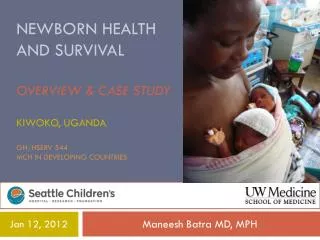
Newborn health and survivalOverview & Case StudyKiwoko, UgandaGH/HSERV 544MCH in Developing Countries Maneesh Batra MD, MPH Jan 12, 2012
Goals • Provide an overview of the current status of Newborn Survival in the world • Place Newborn Survival within the context of Childhood Survival in the world • Provide an in-country example • Highlight potential areas for intervention to improve Newborn Survival
The Newborn Period is Risky - Pop Quiz Each year _ million children (<5 yrs old) die ~8.8 million Each year _ million infants (<1 yr old) die ~5.9 million Each year _ million newborns (<1 mo old) die ~3.6 million = 10,000 per day! How many die within the first 24 hrs of life ? ~1.8 million Black, 2010
Millennium Development Goals • 2000 UN Millennium Declaration: • Eradicate extreme poverty and hunger • Achieve universal primary education • Promote gender equality and empower women • Reduce child mortality • Improve maternal health • Combat HIV/AIDS, malaria and other diseases • Ensure environmental sustainability • Develop a global partnership for development • MDG-4 • “Reduce Child Mortality by 2/3 between 1990 and 2015”
Childhood Deaths…Where? Black, Lancet 2010
Childhood Deaths…Why? Black, Lancet 2010
Neonatal Deaths – Why? • Physiologic adjustments and adaptation to extrauterine life: • Establish breathing • Change fetal circulation to newborn • Body temperature regulation • Feeding and digestion • Immune system development • Recognizing illness is a challenge • Majority of births occur at home
Neonatal Deaths – Where? • 66% in 10 countries • 99% in low/middle income countries • Majority of deaths occur in-home, not in a health facility
Causes of Neonatal Deaths Lawn, Sem Peri 2010
Neonatal Deaths – Why? • 60-80% of neonatal deaths occur in babies with birth weight <2500g • Risk of early death: • 1500-2499g, 6 times greater • <1500g, 100 times greater
How… • ~3 million newborn deaths can be prevented with low-cost, low-tech interventions • ~$1 per inhabitant per year! • Marginal cost of adding neonatal resuscitation training and equipment for midwives: <$0.02 per capita per year • Most deaths could be prevented with simple interventions such as: • Thermoregulation • Breast feeding, Kangaroo care • Early treatment of infections • A very small minority of patients require costly intensive care
Stillbirths Newborn deaths Maternal deaths Child Deaths Childhood Pre-pregnancy Pregnancy Birth Newborn/postnatal Risk of Mortality Peaks Around Childbirth Courtesy of ZA Bhutta
Case Study Kiwoko, Uganda
Setting - Uganda • Population: 27 million • 84% rural • Languages: English, Luganda, Swahili • Literacy Rate: • 69% (male), 59% (female) • Per capita GNP: $270 • Fertility rate: 7.1 (5th in world) • Malnourished Children: 26% • Life expectancy: 42 years
Setting - Uganda • Per Capita Govt healthcare spending: $5 • NMR: 29/1000 live births • Annual Neonatal Deaths 40,900 • IMR: 88.3/1000 live births • U5MR: 137/1000 live births • MMR: 435/100,000 live births • Annual Maternal Deaths: 6,100 • Stillbirths: 31/1000 deliveries
Setting - Uganda 21% of childhood deaths are newborns Opportunities for Africa’s Newborns, 2006
Setting – Luwero District • Area: 5773.53 sq. km • Population: 492,184 (proj. 2000) • 91.1% rural • Population within 5 km of a health services unit: 53%. • Doctors to Population Ratio • 1:23,438 • 16 doctors in the district • IMR: 112/1000 live births • U5MR: 150/1000 live births
Setting – Luwero District • Immunization Coverage: 46% • Stunting Rate: 36% • Acute Malnutrition: 7% • Antenatal Care • ANC attendance rate: 75 % • Delivery by trained staff: 36 % • Access to Safe Water: 42% • Latrine Coverage: 54%
Kiwoko Hospital • Early 1990s - Abandoned school into a health clinic by Dr. Ian Clarke • One of 3 hospitals in the district • 4 full time doctors • Serves population of 500,000 • Treats 25,000 people per year • 1000 deliveries per year • 1500 operations per year • Most patients arrive by foot or bicycle
Kiwoko Hospital • 150-250 beds • 8 wards (Peds, Malnutrition, Male, Female, Surgical, TB, Maternity, NICU) • Outreach/Education
Kiwoko Hospital - Resources • Majority of care by family members • Sporadic electricity • Rain + well water • Limited vaccine supply • BCG, DTP, Td, Measles, OPV • Limited laboratory • Limited medication supply • Limited blood supply
Kiwoko Hospital - NICU Built by ISIS, opened in 1999
Kiwoko Hospital - NICU Primary Diagnoses: • LBW, Sepsis, Tetanus, Malaria, Meningitis, Asphyxia, Meconium Aspiration, Respiratory Distress
Kiwoko Hospital - NICU • 20 beds, 3 functioning incubators • ½ of admissions inborn • Overall Mortality 20-30% • Tetanus Mortality 80-90%
Why do babies die in Luwero? At Home • Largely unknown magnitude and scope of problem • Barriers to seeking care • Knowledge • $$$$$$$$$ • Impact on family unit • What if the baby dies? • Critical point of intervention!
Why do babies die in Luwero? In the Hospital • In-born • LBW • Sepsis • Asphyxia • Out-born • Delayed presentation • LBW • Sepsis, Meningitis, Skin infections • Tetanus • ? Etiology • Majority present with non-specific signs
Improving Newborn Outcomes Framework • Antenatal • Antenatal care • Immunization • Malaria treatment • Maternal nutrition • Birth spacing • Breast feeding counselling
Improving Newborn Outcomes Framework • Peripartum • Skilled birth attendant • Immediate newborn care • Obstetric emergencies
Improving Newborn Outcomes Framework • Postpartum • Recognition of illness • Appropriate initial stabilization • Prevent hypoglycemia • Maintain temperature • Eye care • Prevent/treat infections • Nutritional management of LBW • Availability of referral care • Birth spacing