The Gilded Age
80 likes | 218 Vues
Mark Twain's observation on the pursuit of wealth captures the essence of the Gilded Age, a period marked by the rapid opening of the West, mass immigration, urbanization, industrialization, and political corruption. Key themes include the Pacific Railway Act of 1862, which facilitated two transcontinental railroad lines and relied heavily on immigrant labor. Central and Union Pacific railroads employed different labor forces under harsh conditions. This era raises crucial questions about the motivations behind the railroad's construction and the impact on Native American populations.


The Gilded Age
E N D
Presentation Transcript
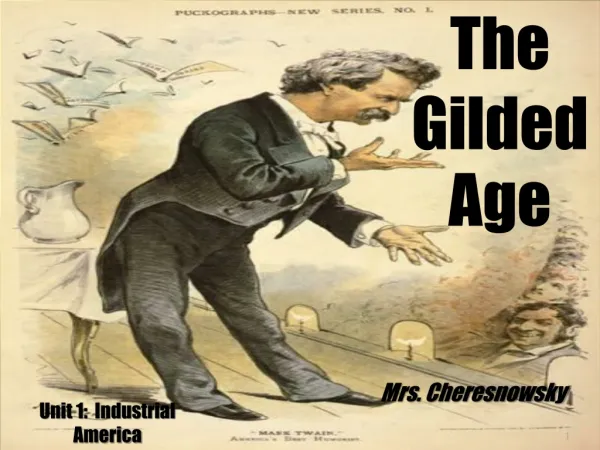
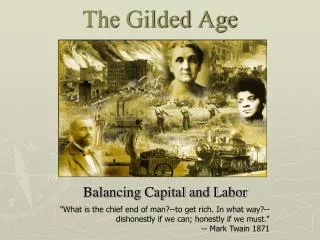
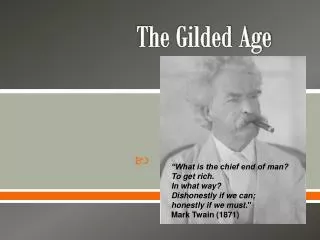
The Gilded Age “What is the chief end of man? To get rich. In what way? Dishonestly if we can; honestly if we must." Mark Twain (1871)
Five Major Themes: • Opening of the West • Immigration & Urbanization • Industrialization • Politics – Corruption & Reform • Labor Movements
Pacific Railway Act (1862) • charters two transcontinental RR lines • Union Pacific • Central Pacific • provided for federal subsidies (government money)… public land • immigrant labor
Labor • Central Pacific crews consisted primarily of Chinese workers • White workers usually earned $40-60 per month for ten hour days, plus meals • Chinese workers earned $35 per month for dawn to dusk hours, provided own food • Snow was frequently so deep (up to 40 feet), they would tunnel into it to live and work • Union Pacific workers were primarily Civil War vets and Irishmen • Hell on Wheels
Conquest of the Western Indians • “The white children have surrounded me and have left me nothing but an island” -Sioux Chief Red Cloud, 1870 • -”permanent Indian country”?
Why the urgent need for a railroad? • Why was there such an urgent need for a transcontinental railroad in the late 1800s? What motivations existed for its creation, and the governments willingness to spend so much money to connect California to the Midwest/East Coast? • Write down at least two motivations, and why they were so important