
SlideServe
Menu
Préférences
© SlideServe · v2026

OUR FLORIDA CORAL REEFS

keena avatar
31 diapositives · 584 Views · Jul 10, 2014

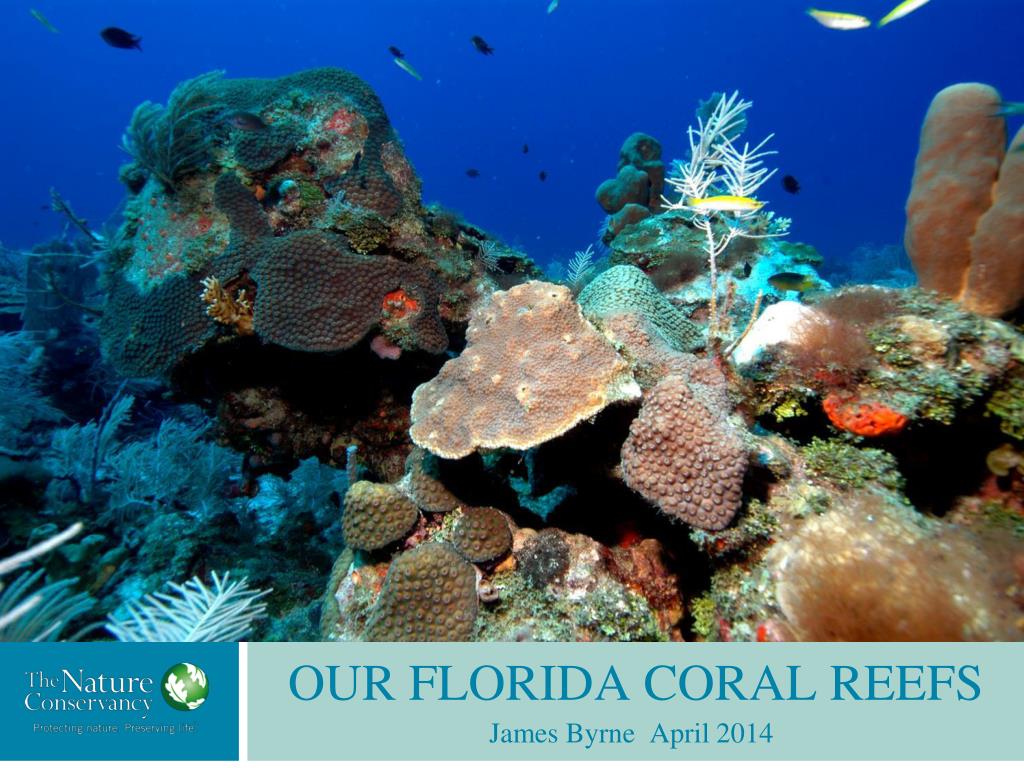
OUR FLORIDA CORAL REEFS. James Byrne April 2014. Where are Florida’s Coral Reefs?. Spans over 300 nautical miles from the Dry Tortugas to Stuart. The only tropical coral reef system, and one of the greatest natural resources, in Florida and the continental United States.
OUR FLORIDA CORAL REEFS - slide 1
01 / 31OUR FLORIDA CORAL REEFS
1 / 17

Télécharger la présentation

OUR FLORIDA CORAL REEFS
Une image / un lien ci-dessous est fourni (tel quel) pour télécharger la présentation

Politique de téléchargement : le contenu du site vous est fourni TEL QUEL pour votre information et votre usage personnel ; il ne peut être vendu, concédé sous licence ni partagé sur d’autres sites sans l’accord de son auteur.Le contenu vous est fourni TEL QUEL, pour votre information et votre usage personnel uniquement. Téléchargez la présentation en cliquant sur ce lien. Lors du téléchargement, si vous ne parvenez pas à télécharger une présentation, l’éditeur a peut-être supprimé le fichier de son serveur.Pendant le téléchargement, si vous ne parvenez pas à obtenir une présentation, le fichier a peut-être été supprimé par l’éditeur.

F I N

Plus de contenu associé

Transcription de la présentation
  1. OUR FLORIDA CORAL REEFS James Byrne April 2014

  2. Where are Florida’s Coral Reefs? • Spans over 300 nautical miles from the Dry Tortugas to Stuart. • The only tropical coral reef system, and one of the greatest natural resources, in Florida and the continental United States. • Adjacent to one of the most densely populated and urbanized coastal communities in the U.S. • 1/3 of Florida’s population (6 billion people) • Coastal population has grown 64% since 1990 • 30 million visitors/year

  3. Florida’s Coral Reefs are home

  4. Benefits

  5. Florida’s Reefs are essential to our way of life. • Tourism, recreation and fishing are the basis of Florida’s economy and the Floridian lifestyle. • Reef-related tourism, diving and fishing annually provide: • $6.3 billion in sales and income • 71,000 jobs • 70% of sales attributed to visitors • Florida’s reefs provide shelter, food and breeding sites for many recreational and commercial fishery species. • Reefs generate sand for our beaches and protect our shorelines from tropical storms and erosion.

  6. Florida’s Reefs are threatened. 1957 1980’s 2007

  7. Florida’s Reefs have been damaged. Photo Series: Phil Dustin

  8. Cumulative Impacts Reefs at Risk Revisited (Burke et al, 2011)

  9. Cumulative Impacts Reefs at Risk Revisited (Burke et al, 2011)

  10. State of the Reef System Overfishing/LBSP/Climate Change 2014 Reef condition 1950 2000 2050 2100

  11. State of the Reef System Threat Abatement Alone Status Quo Overfishing/LBSP/Climate Change 2014 Reef condition 1950 2000 2050 2100

  12. State of the Reef System Ecosystem Restoration + Threat Abatement Threat Abatement Alone Status Quo Overfishing/LBSP/Climate Change 2013 Reef condition 1950 2000 2050 2100

  13. Florida Reef Resilience Program (FRRP) • Origin: Discussions between NOAA, GBRMPA, State of Florida, TNC • Resilience based management concept • Monitoring of entire reef tract • Goals • Identify reefs that are likely to resist or recover from bleaching • Guide the protection & management of those reef areas

  14. A Public and Private Partnership

  15. Coral Bleaching Healthy vs. Bleached

  16. Impacts of Coral Bleaching • Bleaching can lead to disease and sometimes death. • Death due to bleaching reduces coral reef biodiversity by decreasing coral species and coral cover. • Declines in coral cover can cause a decrease inabundance of reef fish and a large decline in the number of reef species.* Bleaching, disease, and death of inshore patch reefs in the Florida Keys (Marilyn E. Brandt, University of Miami) * Jones, G. P. et. al. 2004. Coral decline threatens fish biodiversity in marine reserves. Proceedings of the National Academy of Sciences of the United States of America 101:8251-8253.

  17. Disturbance Response Monitoring (DRM) • Monitor coral reef health after disturbances • 2005-12 focused on coral bleaching • Trained experts survey stony corals on FL reef tract during peak annual temperatures (6-8 weeks) • Follow-up surveys after moderate/severe bleaching years (e.g. 2005) • Can be used for other disturbances (e.g. hurricanes, cold water)

  18. Species level identification • Degree of bleaching and presence of disease • Data entered online • Database queried for results DRM Field Methods • Random sites generated and assigned to teams • 1 x 10m belt transects (2/site) • Measure/assess all corals (>=4 cm)

  19. FRRP Survey Sites 2005–2013 1758 Surveyed Sites

  20. 2013 Bleaching Extent By Zone • 100 surveyed sites • Mild to moderate bleaching (0-50%) • Moderate bleaching occurring in Upper Keys, Biscayne and Broward sub-regions due to paling.

  21. 2005-2010 Data Analysis Inverse distance weight interpolations of FRRP data

  22. FRRP Website • www.frrp.org

  23. Bleaching Response Plan Chapter 1: Early Warning System Chapter 2: Impact Assessment Chapter 3: Communications Chapter 4: Management Actions

  24. Enhancing Coastal Protection Coastalresilience.org

  25. Example: Reef Wave Attenuation Wave heights during storm No live coral on reef Role of Coral

  26. What we need to do Mitigation: Reduce rate & magnitude of sea temperature change Reef condition • Increase resilience: • Refugia • Water quality • Biodiversity • Connectivity “Resilience threshold” 1900 2000 2100 2200 Year

  27. THANK YOU James Byrne jbyrne@tnc.org