Optimizing Variable Rate Fertilizer Applications: Insights from Oklahoma State University
150 likes | 271 Vues
This presentation by Randy Taylor from Oklahoma State University delves into the complexities of variable rate fertilizer application, focusing on field and equipment scale variability. It examines macro- and micro-variability linked to soil type and landscape position, highlights the challenges of achieving effective liquid and granular delivery systems, and discusses innovations like sub-meter application systems and section control technologies. The aim is to improve resolution in fertilization through better understanding and management of variability and controller performance.


Optimizing Variable Rate Fertilizer Applications: Insights from Oklahoma State University
E N D
Presentation Transcript
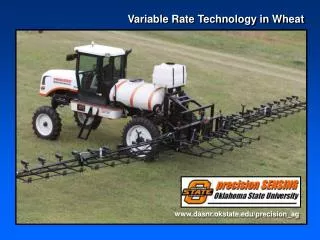
Variable Rate Fertilizer at Reduced Scales Randy Taylor Biosystems and Agricultural Engineering Oklahoma State University 2010 NUE Conference Stillwater, OK
Field Scale Variability • Macro-variability • Likely tied to soil type, landscape position, or something else • Micro-variability
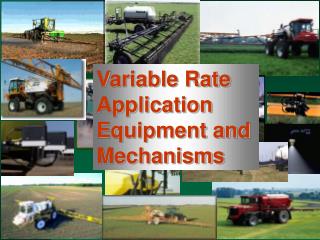
Variability View from Equipment • Longitudinal • Down-the-row • Response time issues • Lateral • Across the boom • Boom divisions A greater distance between the control and delivery points means a lower resolution and increased scale.
Liquid Systems • The initial sub-meter application system met market resistance • However, sensor based VRA has found commercial success • Section control systems have also renewed the interest in sub-boom width application
Liquid Systems • Most commercial rate controllers can be set to about a 2 second response time. • Multiple control sections will require multiple control valves and possibly flow meters. • Pulse width modulation and binary valve systems have promise.
Granular VRT • Granular distribution/delivery systems follow two basic designs • Gate/belt or chain/spinner • Metering wheel/air boom • While both systems can be used for variable rate application, reducing the application scale to a partially width is really not feasible
Spinner Spreaders • Reducing application scales with spinner spreaders is really not feasible. • The material is centrally metered and distributed. • Furthermore, VRA with spinner spreaders is a challenge. • Spread distribution patterns are typically a function of flow rate onto the spinner
Air Boom Systems • The material is centrally metered, but patterns are created locally. • The primary challenge is lag time from the metering system to the point of application
Potential Solutions • The central hopper/conveying system might be a good model to follow
Rate Controllers and Tuning • Prescriptions should not be developed without considering rate controller performance. • Worry about the macro variability within the field. • Are you capturing the general trend?
Questions Randy Taylor Randy.Taylor@okstate.edu 405-744-5431