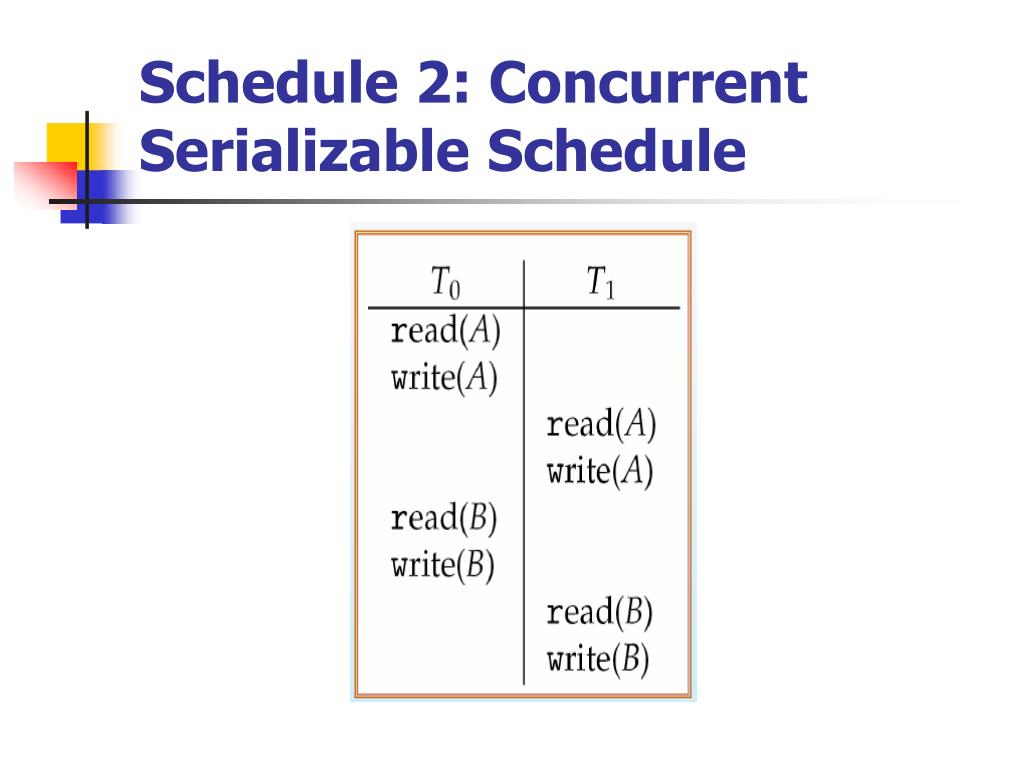
Schedule 2: Concurrent Serializable Schedule. Timestamp Timestamp-based Protocols. Select order among transactions in advance – timestamp-ordering Transaction Ti associated with timestamp TS(Ti) before Tistarts TS(Ti) < TS(Tj) if Ti entered system before Tj
Une image / un lien ci-dessous est fourni (tel quel) pour télécharger la présentation
Politique de téléchargement : le contenu du site vous est fourni TEL QUEL pour votre information et votre usage personnel ; il ne peut être vendu, concédé sous licence ni partagé sur d’autres sites sans l’accord de son auteur.Le contenu vous est fourni TEL QUEL, pour votre information et votre usage personnel uniquement.Téléchargez la présentation en cliquant sur ce lien.Lors du téléchargement, si vous ne parvenez pas à télécharger une présentation, l’éditeur a peut-être supprimé le fichier de son serveur.Pendant le téléchargement, si vous ne parvenez pas à obtenir une présentation, le fichier a peut-être été supprimé par l’éditeur.
Timestamp Timestamp-based Protocols • Select order among transactions in advance –timestamp-ordering Transaction Ti associated with timestamp TS(Ti) before Tistarts • TS(Ti) < TS(Tj) if Ti entered system before Tj • TS can be generated from system clock or as logical counter incremented at each entry of transaction
Timestamp Timestamp-based Protocols • Timestamps determine serializability order • If TS(Ti) < TS(Tj), system must ensure produced schedule equivalent to serial schedule where Ti appears before Tj
Timestamp Timestamp-based Protocols Data item Q gets two timestamps • W-timestamp(Q) –largest timestamp of any transaction that executed write(Q) successfully • R-timestamp(Q) –largest timestamp of successful read(Q) Updated whenever read(Q) or write(Q) executed
Timestamp Timestamp-based Protocols • Suppose Ti executes read(Q) • If TS(Ti) < W-timestamp(Q), Ti needs to read value of Q that was already overwritten Read operation rejected and Ti rolled back • If TS(Ti) ≥W-timestamp(Q) Read executed, R-timestamp(Q) set to max(R-timestamp(Q), TS(Ti))
Timestamp Timestamp-based Protocols Suppose Ti executes write(Q) • If TS(Ti) < R-timestamp(Q), value Q produced by Ti was needed previously and Ti assumed it would never be produced Write operation rejected, Ti rolled back • If TS(Ti) < W-tiimestamp(Q), Ti attempting to write obsolete value of Q Write operation rejected and Ti rolled back • Otherwise, write executed
Timestamp Timestamp-based Protocols • Any rolled back transaction Ti is assigned new timestamp and restarted • Algorithm ensures conflict serializability and freedom from deadlock
The Process Process: a program in execution • Text section: program code • program counter (PC) • Stack: to save temporary data • Data section: store global variables • Heap: for memory management
Stack and Queue • Stack: First in, last out • Queue: First in, first out • Do: push(8) push(17) push(41) pop() push(23) push(66) pop() pop() pop()
Heap (Max Heap) Provide O(logN) to find the max 97 53 59 26 41 58 31 16 21 36
The Process • Program itself is not a process, it’s a passive entity • A program becomes a process when an executable (.exe) file is loaded into memory. • Process: a program in execution
Schedulers • Short-term scheduler is invoked very frequently (milliseconds) ⇒(must be fast) • Long-term scheduler is invoked very infrequently (seconds, minutes) ⇒(may be slow) • The long-term scheduler controls the degree of multiprogramming
Schedulers Processes can be described as either: • I/O-bound process–spends more time doing I/O than computations, many short CPU bursts • CPU-bound process–spends more time doing computations; few very long CPU bursts
Schedulers • On some systems, the long-term scheduler maybe absent or minimal • Just simply put every new process in memory for short-term scheduler • The stability depends on physical limitation or self-adjustment nature of human users
Schedulers • Sometimes it can be advantage to remove process from memory and thus decrease the degree of multiprogrammimg • This scheme is called swapping
Share Memory Parallelization System Example m_set_procs(number): prepare number of child for execution m_fork(function): childes execute “function” m_kill_procs(); terminate childs
Real Example main(argc , argv) { int nprocs=9; m_set_procs(nprocs); /* prepare to launch this many processes */ m_fork(slaveproc); /* fork out processes */ m_kill_procs(); /* kill activated processes */ } void slaveproc() { int id; id = m_get_myid(); m_lock(); printf(" Hello world from process %d\n",id); printf(" 2nd line: Hello world from process %d\n",id); m_unlock(); }
Real Example int array_size=1000 int global_array[array_size] main(argc , argv) { int nprocs=4; m_set_procs(nprocs); /* prepare to launch this many processes */ m_fork(sum); /* fork out processes */ m_kill_procs(); /* kill activated processes */ } void sum() { int id; id = m_get_myid(); for (i=id*(array_size/nprocs); i<(id+1)*(array_size/nprocs); i++) global_array[id*array_size/nprocs]+=global_array[i]; }
Shared-Memory Systems • Unbounded Buffer: the consumer may have to wait for new items, but producer can always produce new items. • Bounded Buffer: the consumer have to wait if buffer is empty, the producer have to wait if buffer is full
Bounded Buffer (producer iew) while (true) { /* Produce an item */ while (((in = (in + 1) % BUFFER SIZE count) == out) ; /* do nothing --no free buffers */ buffer[in] = item; in = (in + 1) % BUFFER SIZE; }
Bounded Buffer (Consumer view) while (true) { while (in == out) ; // do nothing --nothing to consume // until remove an item from the buffer item = buffer[out]; out = (out + 1) % BUFFER SIZE; return item; }
Message-Passing Systems • A message passing facility provides at least two operations: send(message),receive(message)
Message-Passing Systems • If 2 processes want to communicate, a communication link must exist It has the following variations: • Direct or indirect communication • Synchronize or asynchronize communication • Automatic or explicit buffering
Message-Passing Systems • Direct communication send(P, message) receive(Q, message) Properties: • A link is established automatically • A link is associated with exactly 2 processes • Between each pair, there exists exactly one link
Message-Passing Systems • Indirect communication: the messages are sent to and received from mailbox send(A, message) receive(A, message)
Message-Passing Systems Properties: • A link is established only if both members of the pair have a shared mailbox • A link is associated with more than 2 processes • Between each pair, there exists a number of links
Message-Passing Systems • Synchronization: synchronous and asynchronous Blocking is considered synchronous • Blocking send has the sender block until the message is received • Blocking receive has the receiver block until a message is available
Message-Passing Systems • Non-blocking is considered asynchronous • Non-blocking send has the sender send the message and continue • Non-blocking receive has the receiver receive a valid message or null
MPI Program example #include "mpi.h" #include <math.h> #include <stdio.h> #include <stdlib.h> int main (int argc, char *argv[]) { int id; /* Process rank */ int p; /* Number of processes */ int i,j; int array_size=100; int array[array_size]; /* or *array and then use malloc or vector to increase the size */ int local_array[array_size/p]; int sum=0; MPI_Status stat; MPI_Comm_rank (MPI_COMM_WORLD, &id); MPI_Comm_size (MPI_COMM_WORLD, &p);
MPI Program example if (id==0) { for(i=0; i<array_size; i++) array[i]=i; /* initialize array*/ for(i=1; i<p; i++) MPI_Send(&array[i*array_size/p], /* Start from*/ array_size/p, /* Message size*/ MPI_INT, /* Data type*/ i, /* Send to which process*/ MPI_COMM_WORLD); for(i=0;i<array_size/p;i++) local_array[i]=array[i]; } else MPI_Recv(&local_array[0],array_size/p,MPI_INT,0,0,MPI_COMM_WORLD,&stat);
MPI Program example for(i=0;i<array_size/p;i++) sum+=local_array[i]; MPI_Reduce (&sum, &sum, 1, MPI_INT, MPI_SUM, 0, MPI_COMM_WORLD); if (id==0) printf("%d ",sum); }
Chapter4 • A thread is a basic unit of CPU utilization. • Traditional (single-thread) process has only one single thread control • Multithreaded process can perform more than one task at a time example: word may have a thread for displaying graphics, another respond for key strokes and a third for performing spelling and grammar checking
Multithreading Models • Support for threads may be provided either at the user level, for user threads, or by the kernel, for kernel threads • User threads are supported above kernel and are managed without kernel support • Kernel threads are supported and managed directly by the operating system
Multithreading Models • Ultimately, there must exist a relationship between user thread and kernel thread • User-level threads are managed by a thread library, and the kernel is unaware of them • To run in a CPU, user-level thread must be mapped to an associated kernel-level thread
Many-to-one Model • It maps many user-level threads to one kernel thread • Thread management is done by the thread library in user space, so it is efficient • But the entire system may block makes a block system call. • Besides multiple threads are unable to run in parallel on multiprocessors
One-to-one Model • It provide more concurrency than the many-to-one model by allowing another thread to run when a thread makes a blocking system call • It allows to run in parallel on multiprocessors • The only drawback is that creating a user thread requires creating the corresponding kernel thread • Most implementation restrict the number of threads create by user
Many-to-many Model • Multiplexes many user-level threads to a smaller or equal number of kernel threads • User can create as many threads as they want • When a block system called by a thread, the kernel can schedule another thread for execution
CPU Scheduler • Whenever the CPU becomes idle, the OS must select one of the processes in the ready queue to be executed • The selection process is carried out by the short-term scheduler
Dispatcher • Dispatcher module gives control of the CPU to the process selected by the short-term scheduler • It should work as fast as possible, since it is invoked during every process switch • Dispatch latency– time it takes for the dispatcher to stop one process and start another running
Scheduling Criteria CPU utilization – keep the CPU as busy as possible (from 0% to 100%) Throughput – # of processes that complete their execution per time unit Turnaround time – amount of time to execute a particular Process Waiting time – amount of time a process has been waiting in the ready queue Response time – amount of time it takes from when a request was submitted until the first response is produced
Scheduling Algorithems • First Come First Serve Scheduling • Shortest Job First Scheduling • Priority Scheduling • Round-Robin Scheduling • Multilevel Queue Scheduling • Multilevel Feedback-Queue Scheduling
Connexion au compte
Connectez-vous pour publier votre contenu sur SlideServe.