Male Mating History and Female Fecundity in Lepidoptera: Do Male Virgins Make Better Partners?
This study investigates the role of male mating history in female fecundity among Lepidoptera species. By comparing the reproductive outputs of male virgins and experienced males, it seeks to determine whether mating history influences the number of eggs produced. Utilizing fixed and random effects models in meta-analysis, weight estimation, and heterogeneity assessment, the research aims to clarify underlying biases in previous studies and facilitate a deeper understanding of mating dynamics in these insects. Statistical visualization and effect size analysis further enhance our comprehension of the data.

Male Mating History and Female Fecundity in Lepidoptera: Do Male Virgins Make Better Partners?
E N D
Presentation Transcript
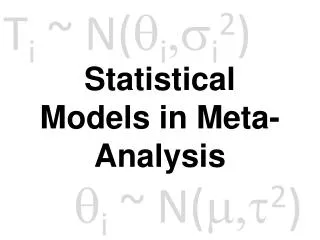
Ti ~ N(qi,si2) Statistical Models in Meta-Analysis qi ~ N(m,t2)
Start with a Question! Male mating history and female fecundity in the Lepidoptera: do male virgins make better partners? Agrotissegetum - wikipedia Torres-Villa and Jennions 2005
Metric: Compare Virgins v. Experience Males in Number of Eggs Produced Hedge's D: D converted from raw data or correlations
Visualize the Data: Forest Plot gm_mod <- rma(Hedges.D, Var.D, data=lep, method="FE") forest(gm_mod, cex=1.3, slab=lep$Species) text(6, 27, "Hedge's D [95% CI]", pos=2, cex=1.3)
Data Visualization: Why • See the data! • Find pathological behaviors • Understand influence of studies on results • Evaluate sources of heterogeneity
A First Stab at a Model: Fixed Effects • Starting model: there is only one grand mean, everything else is error Ti = qi + ei where qi = m ei ~ N(0,si2)
A First Stab at a Model: Fixed Effects • Starting model: there is only one grand mean, everything else is error Ti~ N(qi, si2) where qi = m
Meta-Analytic Mean: Estimation Study Weight: Grand Mean: Weighted mean normalized over all weights! wi/sum(wi) gives you the individual study weight
Is our Effect Different from 0? Study Weight: T-test: (m-m0)/sm with K-1 DF Variance: Confidence Interval m ± sm ta/2,k-1
Fitting a Fixed Effect Model in R > rma(Hedges.D, Var.D, data=lep, method="FE") Fixed-Effects Model (k = 25) Test for Heterogeneity: Q(df = 24) = 45.6850, p-val = 0.0048 Model Results: estimate se zvalpvalci.lbci.ub 0.3794 0.0457 8.3017 <.0001 0.2898 0.4690
Why is a Grand Mean Not Enough • Maybe there's a different mean for each study, drawn from a distribution of effects? • Maybe other factors lead to additional variation between studies? • Maybe both! • If so, we expect more heterogeneity between studies that a simple residual error would predict.
Assessing Heterogeneity • Qt follows a c2 distribution with K-1 DF Test for Heterogeneity: Q(df = 24) = 45.6850, p-val = 0.0048
How Much Variation is Between Studies? • Percent of heterogeneity due to between study variation • If there is no heterogeneity, I2=0
Solutions to Heterogeneity Heterogeneity Allow Variation in q Random Effects Model Model Drivers of Heterogeneity (Fixed) Model Drivers & Allow Variation in q Mixed Effects Model
The Random Effects Approach • Each study has an effect size, drawn from a distribution • We partition within and between study variation • We can 'borrow' information from each study to help us estimate the effect size for each study
A First Stab at a Model: Fixed Effects • Starting model: there is only one grand mean, everything else is error Ti~ N(qi, si2) where qi = m
The Random Effects Model • Each study's mean is drawn from a distribution, everything else is error Ti~ N(qi, si2) qi ~ N(m,t2)
The Random Effects Model • Each study's mean is drawn from a distribution, everything else is error Ti = qi + ei where qi ~ N(m,t2) ei ~ N(0, si2)
There is a Grand MeanStudy Means are from a distributionAlso, there’s additional error…
What is Different? Fixed Effect Study Weight: Random Effect Study Weight: Estimate m and s2m in exactly the same way as before!
What is t2? • Different approximations • We will use the DerSimonian & Laird's method • Varies with model structure • Can be biased! (use ML)
What is t2? • Qt, wi, etc. are all from the fixed model • This formula varies with model structure
Fitting a Random Effect Model in R > rma(Hedges.D, Var.D, data=lep, method="DL") Random-Effects Model (k = 25; tau^2 estimator: DL) tau^2 (estimated amount of total heterogeneity): 0.0484 (SE = 0.0313) tau (square root of estimated tau^2 value): 0.2200 I^2 (total heterogeneity / total variability): 47.47% H^2 (total variability / sampling variability): 1.90 Test for Heterogeneity: Q(df = 24) = 45.6850, p-val = 0.0048 Model Results: estimate se zvalpvalci.lbci.ub 0.3433 0.0680 5.0459 <.0001 0.2100 0.4767
What if we have a group variation drives excessive Heterogeneity? Moths (Heterocera) Butterflies (Rhopalocera)
A Fixed Effect Group Model • Starting model: there are group means, everything else is error Ti~ N(qim,si2) where qim= mm
Estimation of Fixed Effect Models with Groups Just add group structure to what we have already done
Estimation of Fixed Effect Models with Groups Study Weight: Weighted mean normalized over all weights in group m! Group Mean: Group Variance:
So…Does Group Structure Matter? • Qt = Qm + Qe • We can now partition total variation into that driven by the model versus residual heterogeneity • Kinda like ANOVA, no?
Within Group Residual Heterogeneity • Just the sum of the residuals from a group means • Km-1 Degrees of Freedom where Km is the sample size within a group • Tells you whether there is excessive residual heterogeneity within a group
Total Residual Heterogeneity • Just the sum of the residuals from the group means • n - M Degrees of Freedom • Is there still excessive heterogeneity in the data?
Modeled Heterogeneity • Just the sum of the residuals from the group means • Wm = sum of group weights • M-1 Degrees of Freedom for a c2 test • Does our model explain some heterogeneity?
Put it to the Test! > rma(Hedges.D ~ Suborder, Var.D, data=lep, method="FE") Fixed-Effects with Moderators Model (k = 25) Test for Residual Heterogeneity: QE(df = 23) = 45.5071, p-val = 0.0034 Test of Moderators (coefficient(s) 2): QM(df = 1) = 0.1779, p-val = 0.6732
Put it to the Test! > rma(Hedges.D ~ Suborder, Var.D, data=lep, method="FE") ... Model Results: estimate se zval pval ci.lb ci.ub intrcpt 0.3875 0.0496 7.8179 <.0001 0.2903 0.4846 SuborderR -0.0540 0.1281 -0.4218 0.6732 -0.3050 0.1970