Understanding Depression and Its Impact on Relationships
200 likes | 313 Vues
This comprehensive overview explains the multifaceted relationship between depression and interpersonal dynamics. It highlights key symptoms of depression such as mood issues, loss of interest, and cognitive difficulties. The text emphasizes the transactional nature of depression, where social impairments lead to worsened mental health and vice versa. It discusses how depression affects marital quality and satisfaction and explores various therapeutic approaches, including Traditional Behavioral Couples Therapy and Cognitive Therapy. Effective strategies aim to foster understanding and acceptance between partners for better relational outcomes.


Understanding Depression and Its Impact on Relationships
E N D
Presentation Transcript
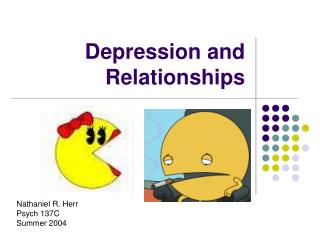
Depression and Relationships Nathaniel R. Herr Psych 137C Summer 2004
What is Depression? • Depressed Mood, Loss of Interest • Also: • Sleep and Eating Problems • Concentration Difficulty • Memory Problems • Feelings of Guilt • Suicidal Thoughts • Episodic, Long-Term Disorder
Interpersonal Impairment • Poorer social skills • Less motivation to interact socially • More irritable • Reassurance-Seeking (Joiner, 1994) • The tendency to excessively ask others for reassurance of worth • Depressed people are not the most fun to be around!
Depression Interpersonal Problems Interpersonal Environment • “Transactional Nature” of Depression • Stress Generation (Hammen) • Vicious Cycle • Reassurance-Seeking Spreads Depression
And as if things weren’t bad enough… • Mate Selection • More depressed partners • More anxious partners • More personality disorder partners • More substance abusing partners • More abusive partners
Effects on Marriage • Depressed Wives: • Poorer Quality Relationships • Poorer Conflict Resolution • Lower Marital Satisfaction • Cause + Effect? • These problems obviously could make someone depressed
What About Men? • Little Research • Worse Marital Satisfaction • But even worse if wife is depressed instead • Wives: • Marital Satisfaction Depression • Depression Marital Satisfaction • Husbands: • Marital Satisfaction Depression • Depression not related Marital Satisfaction • Why?
Summary • Depression causes interpersonal impairment • These problems are “transactional” in nature: • Depression causes social problems, social problems cause depression • Depressed spouses have more marital problems and lower marital satisfaction • Research has typically focused on women, but men have problems too.
Different Approaches to Therapy • Traditional Behavioral Couples Therapy • Cognitive Therapy • Integrative Behavioral Couples Therapy
Traditional Behavioral Couple Therapy (TBCT) • Assessment of couple’s strengths and weaknesses • Specify changes – avoid “not” behaviors • Communication Training • “I” statements • Focus on specific situations • Listening skills – paraphrase, reflection • Problem Solving Training • Define problem, acknowledge each spouse’s role • Evaluate pros and cons • Negotiation, Agreement, Experimentation
Problems with TCBT • Change does not always stay over time • Sometimes there is behavior change, but not a change in marital satisfaction • People don’t want to change!
Cognitive Therapy (CT) • Main Assumption: • Problems come from “faulty cognition” – thinking about things in the wrong way. • Attribute problems to partner (not self) • Unrealistic expectations • Have problematic assumptions (CL) • Selective Attention: Focus on negative
Cognitive Therapy (cont.) • Goal: Identify and change faulty cognitions • Intervention • Teach about cognitive errors • Person as “scientist” • Examine evidence for belief • “Experiments” and homework • Identify exceptions (avoid all-or-nothing thinking) • Use questioning rather than commands
Problems with CT • Favor more “logical” partner • Not well-suited for dealing with emotions • Can overemphasize thinking instead of doing • Focus on specifics can miss the bigger picture • Has not been shown to be more effective than TBCT
Integrative Behavioral Couple Therapy (IBCT; Christensen) • Emphasis on broad themes (instead of specific situations) • Emphasis on Acceptance (instead of change) • Emphasis on “contingency shaped” behavior • TBCT uses “rule-governed” behavior, where rules are imposed to promote change • “Contingency shaped” behavior is when change is elicited by introducing new ideas or situations
Acceptance • Focus on “receiver” not “doer” • Acceptance leads to greater intimacy • Reduces defensiveness • Leads to acknowledgement of responsibility • Acceptance can lead to change • Reduces pressure to change…which actually can help make change • Easier to change when you feel accepted • Easier to accept someone when you see change
Research on IBCT • Currently going on at UCLA (Christensen) • Small amount of research that exists suggests that IBCT works better than TBCT • Addresses some of the problems with TCBT: • Specifically, the emphasis on contingency shaped behavior, not rule based, leads to greater cooperation in treatment and higher marital satisfaction.
Being a Couples Therapist • Interacting with two or more people at once • Working both individually and together • Confidentiality • Trust • Trying not to focus on an “identified patient” • Trying not to take sides • Thinking on your feet and being creative
Summary • TBCT focuses on identifying and changing specific behaviors • CBT focuses on identifying and changing faulty cognitions • IBCT focuses on broad relationship patterns and acceptance of the other • Working with two different people who bring different agendas to therapy is especially difficult for couples therapists