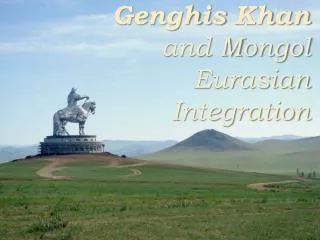
Genghis Khan and Mongol Eurasian Integration
570 likes | 810 Vues
Genghis Khan and Mongol Eurasian Integration. DO NOW: AP M.C. QUESTION. Which of the following is an accurate characterization of both the Incan and Yuan dynasties? Both civilizations developed strict social class hierarchies, in which upward mobility was difficult


Genghis Khan and Mongol Eurasian Integration
E N D
Presentation Transcript
DO NOW: AP M.C. QUESTION • Which of the following is an accurate characterization of both the Incan and Yuan dynasties? • Both civilizations developed strict social class hierarchies, in which upward mobility was difficult • Peasant uprisings were responsible for the establishment of both civilizations • Both the Yuan and the Inca depended on trade as their primary economic activity • Both civilizations flourished under control of outside invaders.
DO NOW: AP M.C. QUESTION • The Mongol Empire was divided into four Khanates, which governed all of the following lands except • Russia • Persia • Japan • Ukriane
QUICK WRITE: • What would you argue are the two strongest impacts or most lasting legacies of Mongol rule?
Nomadic Peoples • Nomadic economy and society • Organized into clans with related languages • Central Asia’s steppes: good for grazing, little rain, few rivers • Nomads and their animals; few settlements • Nomads drove their herds in migratory cycles • Lived mostly on animal products • Also produced limited amounts of millet, pottery, leather goods, iron
Nomadic Peoples and Their Animals • Sheep • Goats • Horses • Mare’s milk • Flock survival
Nomadic Peoples and Their Housing and Clothing • Gers/Yurts • Robes - dei
Caravan Trade Interaction • Nomads and settled peoples sought trade, were prominent on caravan routes
Nomadic Class System • Fluidity of classes in nomadic society • Two social classes; nobles and commoners • Autonomous clans and tribes
Religion • Shamans • Buddhism • Nestorian Christianity • By the tenth century • … Islam
Military Organization • Khan – “RULER” • Organized vast confederation of individual tribes for expansion • Outstanding cavalry forces • Formidable military power
The Mongol Empires • Genghis Khan and the making of the Mongol Empire • Genghis Khan unified Mongol tribes through alliances and conquests • Why was unification necessary? • Tribal group v. Mongol identity • Khan’s personal mission • Trade disruption • Ecology – 1180-1220
Mongol Political Organization • Organized new military units and broke up tribal affiliations • Units based on ten…100…1000… • Leaders had close relationship with Genghis • Chose high officials based on talent and loyalty • Established capital at Karakorum
Mongol Strategy • Horsemanship • Archers • Mobility • Psychological warfare • Feigned withdrawal
Mongol Conquest of Northern China • Genghis Khan, Mongols raided the Jurchen in north China beginning in 1211 • Controlled north China by 1220 • South China was still ruled by Song dynasty
Mongol Conquest of Persia • Genghis Khan tried to open trade and diplomatic relations with Saljuq leader Khwarazm shah, the ruler of Persia in 1218 • Upon being rejected, Genghis Khan led force to pursue Khwarazm • Mongol forces destroyed Persian cities
Death of Genghis Khan • Died in 1227 having laid foundation for a mighty empire
Mongol Division After Genghis Heirs Divide into Four Regional Empires…. • Kubilai Khan-China • Genghis Khan’s grandson • Consolidated Mongol rule in China • Promoted Buddhism, supported the Daoists, Muslims, and Christians
Conquest of Southern China • Khubilai extended Mongol rule to all of China • Song capital at Hangzhou fell in 1276 • Yuan Dynasty founded in 1279 • Unsuccessful conquests of Vietnam, Burma, Java, and Japan
The Golden Horde • Group of Mongols overran Russia between 1237 and 1241 • Jochi and later Batu will rule… • Batu – r.1224-1255 • Further overran Poland, Hungary and eastern Germany, 1241 – 1242 • Maintained hegemony in Russia until the mid-fifteenth century
The Ilkhanate of Persia • Khubilai’s brother, Hulegu captured Baghdad in 1258 • Mongol rule in Persia • Persians served as ministers, governors, and local officials • Mongols cared only about taxes and order • Ilkan Ghazan converted to Islam in 1295 • Massacres of Jews and Christians followed
Mongol Rule in China • 1206 Temujin chosen Genghis Khan of the Mongols • 1227 Death of Genghis Khan • Mongols conquer northern China in 1234 • 1265 Khubilai becomes last Great Khan – rules till death in 1294 • 1271 founding of the Yuan Empire • 1276 - 1279 Mongol conquest of the Southern Song • 1368 Ming Empire founded
Mongols in China • 1265 Khubilai becomes last Great Khan – rules till death in 1294 • By 1279 the Mongols are in control of China • Yuan Dynasty • Short conquest – 1368 the Ming Dynasty is founded
Diplomatic Missions • The four Mongol empires maintained close diplomatic communications • Khanate of Chagatai • Khanate of the Golden Horde • Khanate of the Great Khan • Ilkanate of the Great Khan • Established diplomatic relations with Korea, Vietnam, India, Europe
Mongol Rule in China • Four Classes • Mongols • Central Asians and the Middle Easterners • Northern Chinese • Southern Chinese
Mongol Rule in China • Outlawed intermarriage between Mongols and Chinese • Forbade Chinese from learning the Mongol language • Brought foreign administrators into China and put them in charge • Tolerated all cultural and religious traditions in China
Mongol Ruling Elite • Became enchanted with the Lamaist (Vajrayana) Buddhism of Tibet • Universal leader concept
The Mongols and Eurasian Integration • The Mongols and trade • Mongols worked to secure trade routes and ensure safety of merchants • Elaborate courier network with relay stations • Maintained good order for traveling merchants, ambassadors, and missionaries
Resettlement • Mongols needed skilled artisans and educated individuals from other places • Often resettled them in different locations to provide services • Uigher Turks served as clerks, secretaries, and administrators • Arab and Persian Muslims also served Mongols far from their homelands • Skilled artisans were often sent to Karakorum; became permanent residents
Decline of the Mongols in Persia and China • Had been established by Hulegu by 1260 • Ghazan – declared himself a Muslim in 1295 • Decline of the Il-kanate state • In Persia, excessive spending and overexploitation led to reduced revenues • Failure of the Il-khan’s paper money • Factional struggle plagued the Mongol leadership • The last ruler died without an heir; the Il-khanate collapsed - 1349
Decline of the Yuan Dynasty • Seen as outsiders • Traditional Chinese & outside religions • Rebellions among farmers • Paper money issued by the Mongol rulers lost value • Power struggles, assassinations, and civil war weakened Mongols after 1320s
Bubonic Plague • In southwest China in 1330s • Spread through Asia and Europe • Depopulation and labor shortage undermined the Mongol regime • By 1368 the Chinese drove the Mongols back to the steppes
Surviving Mongol Khanates • The Khanate of Chaghati continued in central Asia • Later – • Timur / Tamerlane • The Golden Horde survived until the mid-sixteenth century • Batu Khan • Sarai – near Volga River
Checking for Understanding: • Why is it argued by historians that the Mongols changed the world, or helped to make the world ‘modern’?
RECOVERY IN CHINAThe Ming Dynasty • Zhu Yuanzhang (Hongwu) overthrew Mongol rule and established the Ming dynasty in 1368 • Ming centralization of government revived Chinese traditions • Reestablished Confucian educational and civil service systems • Emperor ruled China directly without the aid of chief ministers • Mandarins and eunuchs maintained absolute authority of emperors • Mandarins represented central government to local authorities • Eunuchs could not build family fortunes
The Ming Dynasty • Map
Ming Dynasty Promoted Economic Recovery • Repaired irrigation systems • Agricultural productivity soared • Promoted manufacture of porcelain, silk, and cotton textiles • Trade within Asia flourished with increased production
Cultural Revival • Actively promoted neo-Confucianism • Yongle– encyclopedia – massive anthology of cultural traditions
The Chinese Reconnaissance • Zheng He’s expeditions • Ming emperors permitted foreigners to trade in Quanzhou and Guangzhou • Refurbished navy and sent seven ships into Indian Ocean • Purposes of expedition? • Largest marine crafts in the world…
Chinese Naval Power • Visited southeast Asia, India, Ceylon, Arabia, and east Africa • Zheng He’s voyages were diplomatic-exchange of gifts and envoys • Also military – used force to impress foreign powers – ex. coastal pirates • Voyages enhanced Chinese reputation in the Indian Ocean basin
End of Voyages • 1433 • New emperor • Confucian ministers mistrusted foreign alliances • Resources redirected to agriculture and defense of northern borders • Technology of building ships was forgotten, charts destroyed
Forbidden City • 183 acres • 32 feet tall wall • 1406 construction begins • 14 years • 200,000 men • 75 buildings, 9,999 rooms