Nomadic Empires and Eurasian Integration
Nomadic Empires and Eurasian Integration. Chapter 18 Review. Ch 18.1 Turkish Expansion Objectives. Understand the Turkish migrations and imperial expansion and its consequences. Turkish Economy. Nomadic herders; organized into clans with related languages

Nomadic Empires and Eurasian Integration
E N D
Presentation Transcript
Nomadic Empires and Eurasian Integration Chapter 18 Review
Ch 18.1 Turkish Expansion Objectives • Understand the Turkish migrations and imperial expansion and its consequences
Turkish Economy • Nomadic herders; organized into clans with related languages • Turks refer to a large group of peoples • Central Asia's steppes: good for grazing, little rain, few rivers= no Complex Societies • Nomads and their animals; few settlements • Nomads drove their herds in migratory cycles • Lived mostly on animal products • limited amounts of millet, pottery, leather goods, iron
Turkish Society • Fluidity of classes in nomadic society • Two social classes: nobles and commoners • Autonomous clans and tribes • Religions: shamans, Buddhism, Nestorian Christianity; 10th cent Islam major • Military organization • Khan ("ruler") organized vast confederation (alliances) • Outstanding cavalry forces, formidable military power
Saljuq Turks and the Abbasid empire • Next to Abbasid, mid-8th to 10th cent • Moved in; served in Abbasid armies • Controlled Abbasid caliphs by 11th cent • Puppet Gov’t • Extended Turkish rule to Syria, Palestine, and more
Saljuq Turks & Byzantine empire • Large # move into Anatolia, 11th cent • Manzikert 1071, Defeat Byzantine army • Turning Point Byz down Turks up • Made Anatolia an Islamic society
More Turkish Expansion • Remember Mahmud? • Attacks Northern India plunderer • Ghaznavid Turks dominate northern India through sultanate of Delhi
End of Ch 18.1 • Explain the Turkish migrations and their imperial expansion along with the consequences of these events
Ch 18.1 Mongol Empires Objectives • Understand the Turkish migrations and imperial expansion and its consequences
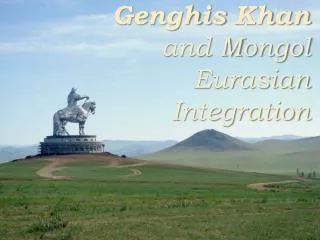
Chinggis Khan makes the Mongol empire • Chinggis Khan ("universal ruler") unified Mongol tribes through alliance and conquests • Mongol political organization • Organized new military units; broke up tribal affiliations • Chose high officials based on talent and loyalty • Established capital at Karakorum • Strategy: horsemanship, archers, mobility, psychological warfare- scare the snot out of…
Mongol Conquest of northern China • Raid Jurchen in north China in 1211 • Controlled north China by 1220 • South China ruled by Song dynasty
Mongol conquest of Persia • 1218 CK tried to set up relations with Khwarazm shah Saljuq leader of Persia • Rejected, bad idea- CK led force to pursue the Khwarazm • Mongol destroy Persian cities & qanats • CK dies 1227, foundation of empire set
Mongols after Chinggis Khan • Empire run by Ogodai - CK’s son • Continued conquest • Dies in 1241 • Empire divided -- four regional empires
Khubilai Khan • CK grandson, consolidated Mongol rule in China • Promoted Buddhism, supported Daoists, Muslims, and Christians • Khubilai extends rule to all of China • Hangzhou (Song) fell 1276, • Yuan Dynasty founded in 1279 • No Luck in of Vietnam, Burma, Java, and Japan
Mongol Rule in China • Outlawed intermarriage between Mongols & Chinese • Chinese couldn’t learn Mongol language • Foreign administrators (Uighurs) put in charge • End civil service examination, downfall of Confucian scholars • Tolerated all cultural and religious traditions in China • Lamaist Buddhism (Tibetan) became popular w/Mongols
The Golden Horde • What a cool name! • Mongols overran Russia 1237 - 1241 • Invaded Poland, Hungary, & e Germany, 1241-1242 • Had hegemony in Russia ‘til mid 15th cent • Hegemony- control by one person/group over others
The ilkhanate of Persia • Hülegü, captured Baghdad in 1258 • Persians served as ministers, governors, and local officials • Mongols only cared about taxes and order • Ilkhan Ghazan converted to Islam, 1295 • massacres of Christians and Jews
Tamerlane (1336-1404) • Had a limp, Timur was self-made • built central Asian empire 1360s; capital in Samarkand • Tamerlane's conquests • First conquered Persia and Afghanistan • Next attacked the Golden Horde • At the end of the fourteenth century, invaded northern India • Ruled the empire through tribal leaders who relied on existing bureaucrats to collect taxes • Tamerlane's heirs struggled and divided empire into four regions
Ottoman Empire- Founding • Osman • Nomadic Turks migrated to Persia and Anatolia • Osman, carves out a small state in northwest Anatolia • Claimed independence from the Saljuq sultan in 1299
Ottoman Conquests • The Balkans (SE Europe) in 1350s • Sultan Mehmed II sacks Constantinople 1453, • renamed it Istanbul • Absorbed the remainder of the Byzantine empire • 16th cent, extended to southwest Asia, southeast Europe, and north Africa