Mapping the Mysteries of Pluto and the Kuiper Belt: Insights and Discoveries
Recent advancements in space exploration have provided deeper insights into the landscape of Pluto and the surrounding Kuiper Belt. Using direct imaging techniques and findings from the Voyager spacecraft, scientists have analyzed light variations caused by Charon during eclipse transits. Pluto's reclassification as a dwarf planet highlights its distinct mass and size compared to traditional planets. The Kuiper Belt's objects, remnants of primitive planetesimals, offer intriguing clues about the formation of our solar system, while comets, including the recently discovered Comet Tosis, demonstrate unique characteristics influencing their orbits.

Mapping the Mysteries of Pluto and the Kuiper Belt: Insights and Discoveries
E N D
Presentation Transcript
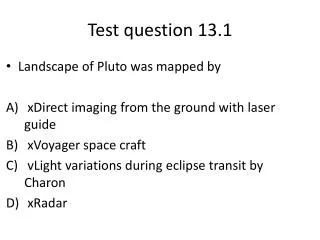
Test question 13.1 • Landscape of Pluto was mapped by • xDirectimaging from the ground with laser guide • xVoyagerspace craft • vLightvariations during eclipse transit by Charon • xRadar
Test question 13.2 • Pluto was recently classified as a dwarf planet because • xItis much further out than normal planets • xItsmass and radius are much smaller than normal planets • xTheyare several Kuiper Belt objects with similar properties • vAllof the above
Test question 13.3 • Kuiper Belt objects are: • xCapturedmaterial from the interstellar medium • xEscapedmoons around planets • xRemains of gas giant planets which lost most of their gas • vRelicsof primitive planetesimals
Test question 13.4 • Kuiper Belt objects are found with: • xMeasureof their Doppler effects • vSearchfor objects which move slightly within a given night • xTakingspectra of faint objects at night • xInterplanetaryspace probes
Test question 13.5 • Comets are thought to have formed much further out from the Sun than planets because • xTheyare dirty snow balls • xTheyhave very long periods • xTheybreak up easily when venture into the inner solar system • vAllof the above
Test question 13.6 • A recently discovered Comet Tosis has a period 8 times that of Comet Halley. The semi major axis of Tosis is • x1/8 that of Comet Halley • xSameas Comet Halley • v4 times that of Comet Halley • x8 times that of Comet Halley