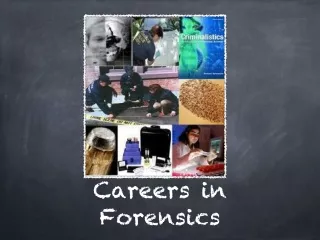
Careers in Forensics
130 likes | 266 Vues
Explore various forensic science careers from odontologist to toxicologist. Learn about the required skills, typical workplaces, and job responsibilities in language suitable for professionals and students.

Careers in Forensics
E N D
Presentation Transcript
Odontologist • An odontologist is a dentist who applies the principles of dentistry to identify human remains and bite marks.
Pathologist • A pathologist is a medical doctor who determines cause of death by performing an autopsy.
Forensic Anthropologist • A forensic anthropologist identifies skeletal remains and determines sex, age, race, or marks of trauma.
Forensic Engineer • A forensic engineer applies engineering concepts in legal situations (for instance accident reconstruction or failure analysis).
Ballistic Analyst • A ballistic analyst examines guns and ammunition and interprets gunshot wounds or gunshot marks and residue.
Document Examiner • A document examiner analyzes written documents. He may study handwriting, typewriting, paper, ink, and any other features of documents.
Serologist • A Serologist identifies and examines blood and other bodily fluids.
Toxicologist • A toxicologist's specialty is poison. A toxicologist determines if drugs or other chemicals (poisons) contributed to the cause of death or were present in a crime.
Forensic Entomologist • An entomologist studies life cycles of insects to help determine the approximate time of death of a victim in a murder investigation.
What skills do these jobs take? • A college degree • Good eye-sight • Keen observation skills • Curiosity and imagination • Ability and patience to work with details • Integrity • Being objective and free of bias and prejudice • Ability to keep accurate records
You may have to appear at a court hearing so... • You must be a skilled speaker • You must have good data management skills • You must be able to keep good scientific records
The Workplace...you may work for: • The local, state, or federal government • For a lab that analyzes different types of evidence • As an independent consultant • In a hospital, office, or university • In the morgue or medical examiners office • At the crime scene