Global Strategies for GHG Reduction: Analyzing Commitments and Future Scenarios
This review explores the challenges and strategies related to stabilizing greenhouse gas (GHG) concentrations to prevent dangerous impacts on the climate system. It compares the European Union's 2°C goal against pre-industrial levels and emphasizes the importance of reducing emissions by 15-30% by 2020 and 75-90% by 2050. It highlights the need for developing nations to shift away from business-as-usual scenarios and discusses the cost-effectiveness of early versus late measures. Additionally, it outlines differing commitments among countries and the implications for future climate agreements.

Global Strategies for GHG Reduction: Analyzing Commitments and Future Scenarios
E N D
Presentation Transcript
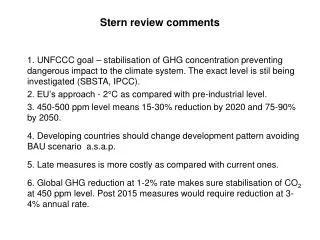
Stern review comments 1. UNFCCC goal – stabilisation of GHG concentration preventing dangerous impact to the climate system. The exact level is stil being investigated (SBSTA, IPCC). 2. EU’s approach - 2°C as compared with pre-industrial level. 3. 450-500 ppm level means 15-30% reduction by 2020 and 75-90% by 2050. 4. Developing countries should change development pattern avoiding BAU scenario a.s.a.p. 5. Late measures is more costly as compared with current ones. 6. Global GHG reduction at 1-2% rate makes sure stabilisation of CO2 at 450 ppm level. Post 2015 measures would require reduction at 3-4% annual rate.
Principles of future commitments UNFCCC basic principle - common but differentiated resposibility Criteria: goals should be economically reasonable, energy efficient, environmentally sound, acceptable for Parties. Target - to reduce GHG emission growth rate
Scenario • Different groups of countries with various commitments is expected scenario. • EU announce its interest in continuation of Kyoto regime. USA is likely to remain current position arguing the developing countries have no strict commitments. • For Russia absolute target with 2012 (instead of 1990) base year scenario seems to be almost unacceptable (if economic policy remains the same). «Soft» commitments are possible but bring no benefits in terms of carbon trading. • Possible options: keep 1990 as a base year with absolute targets or dynamic target - for example 2% annual reduction of per capita energy consumption.