Download
1 / 15
150 likes | 257 Vues
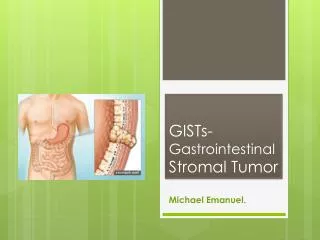
The gastrointestinal tract, also known as the digestive tract, plays a crucial role in digestion, extending from the mouth to the anus. It involves multiple organs, including the stomach, intestines, and accessory organs like the liver and pancreas, each contributing to the breakdown and absorption of nutrients. This overview discusses the anatomy and functions of the GI tract, the process of digestion, and common disorders, including eating disorders, gastroesophageal reflux, and inflammatory bowel diseases. Understanding these components is vital for maintaining digestive health.

E N D
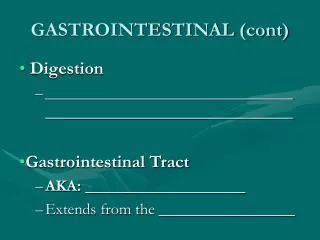
GASTROINTESTINAL (cont) • Digestion • ______________________________________________________________ • Gastrointestinal Tract • AKA: ____________________ • Extends from the _________________
The Mouth • ____________________________________________________________________ • 3 sets of salivary glands surrounding the oral cavity secrete saliva • Saliva contains enzymes (salivary amylase) that ________________ and begins the digestion of _____________ • Three pairs of glands with ducts: • __________________ • __________________ • __________________
GASTROINTESTINAL (cont) • Pharynx • AKA: _____________________ • Passageway for ______________________ • Muscular tube that moves food into the esophagus • _______________ covers the _________________ when we swallow • Esophagus • ______________________ • Involuntary rhythmic contractions of the esophagus to move food to stomach • ______________________ • a group of muscles which closes the entrance to the stomach to prevent backflow of food
GASTROINTESTINAL • The Stomach • Pouch-like organ with four regions • Located in the left hypochondriac region • Receives food from the _____________ ____________________________________________________________________ • Semi fluid material • __________________________ • Muscle between the stomach and small intestine that keeps food in the stomach
GASTROINTESTINAL (cont) • ___________________________ • Receive chyme from the stomach • Absorption occurs over 1 to 6 hours • Begins in the small intestine • Passage of material from the walls of the GI tract to the bloodstream • ______________________________ • Has 3 parts: • ____________________ (10”) • __________________ (8’) • __________________
GASTROINTESTINAL (cont) • ____________________ (5’) • Waste products from digestion stay here for 12 to 24 hours • Has four main parts: • ___________________ (first section) • ___________________ • __________________ • __________________
GASTROINTESTINAL (cont) • The Liver • ________________________ • Not within the GI tract, but performs digestive functions • Changes food nutrients into useable substances • Secretes __________________ • Stores glucose and certain vitamins • Secretes bilirubin
Accessory Organs • _____________________ • Bile released from the liver goes into the gallbladder • ______________________________________ • ____________________ • Secretes pancreatic juice into small intestine • Also an endocrine gland (secretes insulin) • Located behind the stomach
Diseases and Disorders • Eating Disorders • ____________________ – refusal to eat • ____________________ – binging and purging • __________________ – can be caused by overeating • Overweight – less than 20% over ideal body weight • Obese – more than 20% over ideal body weight • Morbid Obese – 100 pounds over ideal body weight
Diseases and Disorders • Halitosis – _______________________ • _________________________– inflammation of the stomach and small intestine • Stomach flu • ____________________– accumulation of gas in the stomach or intestines • Flatus – release of gas through the anus • Eructation - _________________________
Diseases and Disorders • _____________________________ • Also called _______________ or stomach ulcers • Sores on the mucus membranes in the GI tract • Most common cause is ______________________ • Sx: ______________________________________ • Hiatal Hernia – __________________________________________________________________________
Diseases and Disorders • ________________– excessive billirubin in the blood causing _________________ appearance • Result of liver disease • Newborn jaundice is common • _______________ – chronic _________disease caused by chronic hepatitis, poor nutrition, or ___________________________________
Diseases and Disorders • _______________________ • Inflammation of the gallbladder • Typically caused by gall stones • _________________ • Inflammation of the appendix • Sx: abdominal pain, constipation, fever, and elevated WBC count • Tx: surgery
Diseases and Disorders • ___________________________ • Chronic inflammatory bowel disease of the large intestine • Sx: cramping, abdominal pain, diarrhea • Tx: medication • ___________________________ • Similar to Ulcerative Colitis except also affects small intestine • Sx: same as ulcerative colitis
Diseases and Disorders • _____________________ – inflammation of the small pouches of the intestinal wall due to trapped food or bacteria • Sx: abdominal pain, fever • Tx: BR, antibiotics, liquid diet, low fiber diet • When in control managed by dietary changes • Constipation – infrequent or difficult BM • _______________________________________________ • _________________________ – loose, watery stools • _________________________ – swollen, twisted veins that cause discomfort in internal and external anal area