
SlideServe
Menu
Préférences
© SlideServe · v2026

Study Outlining Methods for Better Understanding

kelvin avatar
4 diapositives · 223 Views · Apr 08, 2014

Different outlining methods like flowcharts and bullet points; understand how your brain processes information for effective studying. Learn where to begin, use syllabus, chapter headings, notes, and create an outline with headings, subheadings, rules, cases, and exceptions. Explore closed book vs. open book exams and mini-outline techniques.
Study Outlining Methods for Better Understanding - slide 1
01 / 4Study Outlining Methods for Better Understanding
1 / 17

Télécharger la présentation

Study Outlining Methods for Better Understanding
Une image / un lien ci-dessous est fourni (tel quel) pour télécharger la présentation

Politique de téléchargement : le contenu du site vous est fourni TEL QUEL pour votre information et votre usage personnel ; il ne peut être vendu, concédé sous licence ni partagé sur d’autres sites sans l’accord de son auteur.Le contenu vous est fourni TEL QUEL, pour votre information et votre usage personnel uniquement. Téléchargez la présentation en cliquant sur ce lien. Lors du téléchargement, si vous ne parvenez pas à télécharger une présentation, l’éditeur a peut-être supprimé le fichier de son serveur.Pendant le téléchargement, si vous ne parvenez pas à obtenir une présentation, le fichier a peut-être été supprimé par l’éditeur.

F I N

Plus de contenu associé

Transcription de la présentation
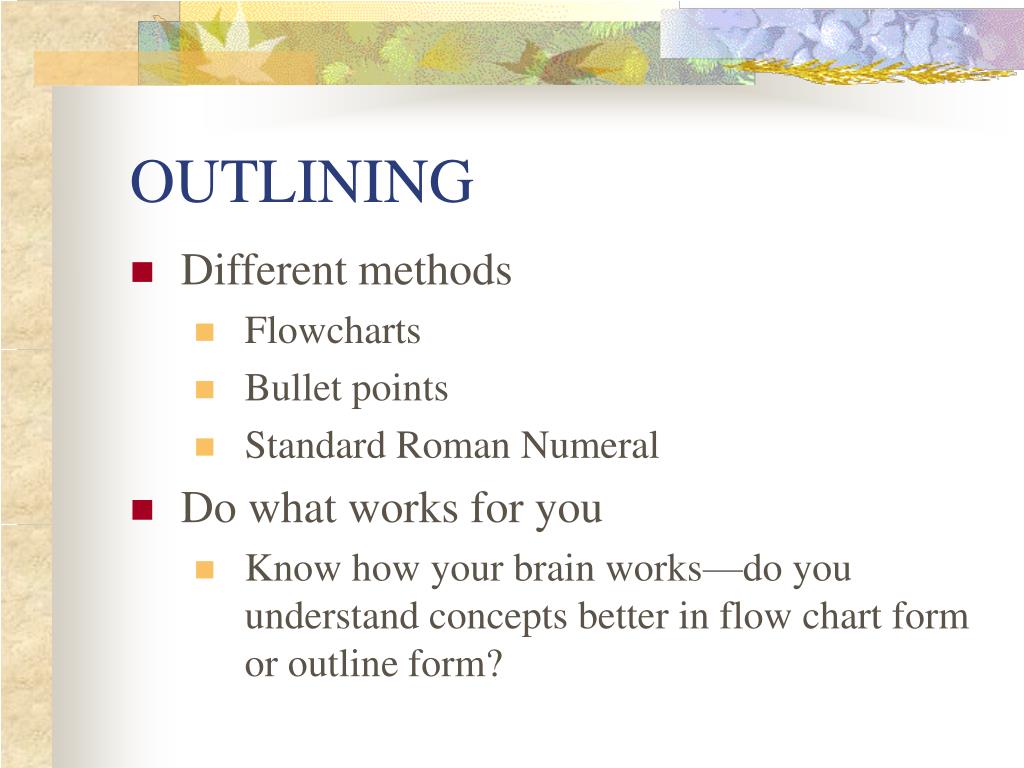
  1. OUTLINING • Different methods • Flowcharts • Bullet points • Standard Roman Numeral • Do what works for you • Know how your brain works—do you understand concepts better in flow chart form or outline form?

  2. Where to Begin • Start with the Syllabus—the syllabus is an outline in itself • Get the big picture • Use your book chapter headings • Take notes while trying to process where the information will fit into the outline • Use your notes to then create an outline

  3. The “Outline” • Headings and subheadings • The Rules and the Exceptions • Policy issues that your professor may have brought up • Cases—for the purposes of serving as examples of how concepts have been applied or to help you understand and jog your memory as to how a concept works • Certain classes have significant cases that you will need to know by name • Closed Book v. Open Book & the “Mini Outline”

  4. Medical Malpractice class outline See Handout Mini Medical Malpractice outline See handout Examples