Overview of Pollution Prevention and Resource Management Specialization at Bren School
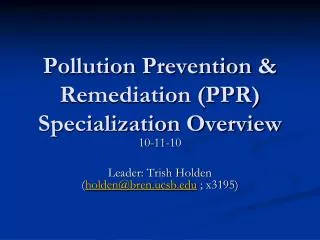
The Pollution Prevention and Resource Management (PPR) specialization at Bren School focuses on the urgent need for efficient waste management in response to rising population and development. Key topics include emerging and legacy pollutants, resource conservation, and remediation strategies. The curriculum emphasizes life cycle analysis, prevention techniques, and industry sustainability. Notably, real-world case studies—such as the 2005 Benzene spill in the Songhua River—highlight critical questions on pollution impact and management strategies. Graduates pursue careers in various environmental sectors.

Overview of Pollution Prevention and Resource Management Specialization at Bren School
E N D
Presentation Transcript
PPR Specialization Overview 9-27-12 Prof. Trish Holden, Bren School
Why PPR ? • Pollution • Waste management: driven by population and development • Emerging pollutants in U.S. , EU, etc. • Legacy pollutants globally (Hg, DDT, etc.) • Soil (agricultural sustainability), water: scarce resources • Prevention • “Greening” of industry / products • Analysis of life cycle (raw materials to end-of-life for products) • Resource conservation • By-product recovery • Remediation • Ex- vs. in-situ • Engineered vs. monitored natural attenuation (frog: http://www.greenchemistrynetwork.org/gcp.htm)
Example problem • 2005 Benzene spill in Songhua River, PRC • Songhua River: drinking water source • Harbin (9 M people) • Other PRC cities • Russia: x-border city of 0.7 M people • Benzene • toxic carcinogen • somewhat soluble in water • volatile • can biodegrade
Example: questions & concerns • How hazardous is this spill for humans and biota? • How far downstream will the pollution travel? • What are the pollutant fates? • What can we do about the pollution, and when? • How can we avoid this in the future? Max. Min. (oxygen sag graphic: http://techalive.mtu.edu/meec/module02/OxygenDepletion.htm)
PPR: Website http://www.bren.ucsb.edu/academics/mesm_specialization/pollut_prevent.htm
PPR Knowledge Pieces Prevention (conservation / substitution Pollution Science (what it is) Economics and Policy (costs/ benefits, feasibility, acceptability) Transport (where it goes) Remediation (treatment /clean-up) Distribution (where it is) Consequences (toxicity/ risk)
Our Example Problem…. ESM 272 ESM 273 ESM 282 Ch E 212 ESM 219 Chem 123 Geog 114/L ESM 243 ESM 245 ESM 281 ESM 222 Ch E 120C Geol 169 Geog 246 Math 130 ESM 214 ESM 223 ESM 224 ESM 263 Geog 276 Geog 277 Geog 278 ESM 213 Envst 120 ESM 299
Classes (example POS) http://www.bren.ucsb.edu/services/student/index.html
YOUR POS • individual POS • initial meeting w/ advisor to discuss background, and goals • follow-up, as desired • suggested classes (website ; example POS) • You may be well-versed already in some... • “Combo” may make sense w/ other specialization, for you • PPR and CEM • PPR and WRM..
Group Projects: past examples • Nanomaterials industry EHS + product stewardship • Evaluation of bacteriological water quality in Las Palmas Creek • Analysis of food scrap recycling to reduce solid waste • Wetlandsmitigation: Casmaliawaste site • Ecological risk of MTBE plume • Goleta Oldtownbrownfields redevelopment • Bioswale management of storm runoff • Pharmaceuticalsin surface waters • Life cycle analysis of eco-sneakers
Jobs: Sectors w/ PPR Grads(see Dave or Kristen for more info)
Jobs: example titles • Project Manager • Environmental Scientist • Environmental Sustainability Analyst • Staff Engineer • Environmental Compliance Specialist • Environmental Protection Specialist
Questions? Trish Holden holden@bren.ucsb.eduoffice: 3508 BH tel: 893-3195