Understanding Chemistry: The Study of Matter and Its Transformations
This chapter delves into the fundamental concepts of chemistry, exploring the nature of matter, atoms, and molecules. It introduces the various branches of chemistry, including physical, analytical, organic, inorganic, and biochemistry, as well as the scientific method used in experimentation. The distinctions between elements, compounds, and mixtures, along with methods of separating mixtures, are covered. The chapter also examines physical and chemical properties and changes, providing a foundational understanding essential for further studies in chemistry.

Understanding Chemistry: The Study of Matter and Its Transformations
E N D
Presentation Transcript
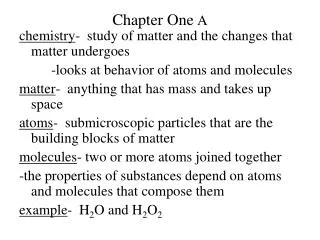
Chapter One A chemistry- study of matter and the changes that matter undergoes -looks at behavior of atoms and molecules matter- anything that has mass and takes up space atoms- submicroscopic particles that are the building blocks of matter molecules- two or more atoms joined together -the properties of substances depend on atoms and molecules that compose them example- H2O and H2O2
Branches of Chemistry 1) physical -studies the behavior of substances ex- how plastics work • analytical -studies the composition of substances ex- blood tests 3) organic -studies substances containing carbon ex- sugars
inorganic -studies substances not containing carbon ex- salts, some acids • biochemistry -studies chemical processes in living organisms ex- digestive, respiratory, circulatory systems pure chem- studies chemistry just for the sake of knowledge alone applied chem- takes that knowledge to attain a specific goal
What makes science different from other subjects? scientific method- systematic approach to problem solving -acquiring knowledge about natural world Steps of the Scientific Method • Propose Problem/ Ask a Question -usually begins with an observation
Gather Info -I-net, books, radio, interviews, newspapers, magazines, TV, videos • Form a Hypothesis -an educated guess, tentative explanation • Test Hypothesis Through Experimenting -experiment should be designed around hypothesis -for results to be accepted, the experiment must produce the same results over and over again
control- does not change variable- what is being changed - only one variable can be tested at a time independent/manipulated variable- what is changed on purpose dependent/responding variable- what happens in response to the manipulated variable being changed
Analyze Results -observations and data should be colleted during experiment -organize data into tables, graphs, charts • Accept/Refute Hypothesis -based on hypothesis and results • Repeat scientific law- brief statement that summarizes past observations and predicts future ones -laws define how nature behaves -we generally accept laws as true without question
example- law of conservation of mass -states that matter can neither be created nor destroyed -laws can often times be equations theory- time tested idea that is widely accepted by the scientific community -theories will explain, laws will not example- Dalton’s Atomic Theory -states that all matter is composed of small indestructible particles called atoms
States of Matter solids- have definite shape and volume -atoms or molecules are tightly packed in fixed locations -atoms/molecules vibrate, but do not move or slide past one another Can be: crystalline- arranged in patterns with repeating order (salt, diamonds) amorphous- no order or repeating pattern (charcoal, plastic)
liquids- have definite volume, but no definite shape, take on the shape of their container -atoms/molecules are free to move gases- take both the shape and volume of their container -atoms/molecules have plenty of space between them and are free to move -this makes gases compressible
Classifying Matter substances- composed of only a single type of atom or molecule -chemical formulas or chemical symbols can be written from substances Substances can be: elements- substances that cannot be broken down into simpler substances -all found on the periodic table compounds- two or more elements chemically combined -ex- NaCℓ or H2SO4
mixtures- composed of two or more different types of matter combined physically in variable proportions Types of mixtures heterogeneous- particles can be picked apart and separated ex- chicken soup, salad homogeneous- uniform composition, the same throughout, particles cannot be separated physically ex- Kool-Aid, iced tea
Separating Mixtures decanting- pouring off the water filtering- use filter paper, separate solid and liquid (page 10 figure 1.6) distillation- heat to boil off liquid, then recondense liquid and collect in a separate flask (page 10 figure 1.5)
Physical changes- alter only appearance, but not composition -usually reversible ex- boiling water, carving wood Physical property- property that a substance displays without changing its composition ex- melting and boiling point, color, odor
Chemical changes- alter the composition of matter, transform into different substances -usually irreversible ex- iron rusting, wood burning Chemical property- property that a substance displays only by changing its composition by ways of a chemical change