Mastering Logarithms: Evaluating and Simplifying Across Any Base
In this excursion on logarithmic functions, we delve into evaluating logarithms across various bases, both with and without a calculator. The session covers solving exponential and logarithmic equations by employing equivalent equations and illustrates the use of properties and laws of logarithms for simplification. Examples guide you through finding values, solving equations for 'x', and expressing logarithms as single entities. We introduce the Change of Base Formula, essential for using calculators that support only base 10 and base e logarithms.

Mastering Logarithms: Evaluating and Simplifying Across Any Base
E N D
Presentation Transcript
Excursion: LogarithmicFunctions to Other Bases 5.5.A Objectives: Evaluate logarithms to any base with and without a calculator. Solve Exponential and logarithmic equations to any base by using an equivalent equation. Use properties and laws of logarithms to simplify and evaluate logarithmic expressions to any base.
Example #1 • Without using a calculator, find each value. B. A. C.
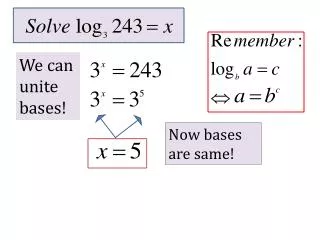
Example #2 • Solve each equation for x.
Example #3 • Solve the equation.
Example #4 • Simplify and write each expression as a single logarithm.
Example #4 • Simplify and write each expression as a single logarithm. Use the hint below just as was done with bases of e and 10.
Example #4 • Simplify and write each expression as a single logarithm. And again an alternative approach:
Change of Base Formula • This formula is the single reason why calculators only build in the base 10 (common log) and base e (natural log). With it, it allows a logarithm of any base to be evaluated. A good way to remember which number goes on top is the fact that the base of the original logarithm always goes in the bottom.
Example #5 • Evaluate the following logarithm using the change of base formula. On the first problem the base was 5, so log 5 was placed in the bottom. On the second problem, ¼ was the base, so log ¼ was placed in the bottom. Also remember either the common log or natural log works on the calculator, just don’t mix and match them on the same ratio.