Download
1 / 15
150 likes | 343 Vues
This resource explores the principles of light physics, focusing on light's straight-line travel and the Law of Reflection. It explains how the angle of incidence equals the angle of reflection across various surfaces, including flat and curved mirrors. Readers will learn about image formation in concave and convex mirrors, including the characteristics of images such as size and orientation. The text also touches on the behavior of light through lenses and introduces Snell's Law for further understanding.

E N D
Lenses and Mirrors Tuesday, July 14, 2009
Model of light • Light travels in a straight line. • Represented by a Ray
Law of Reflection The incoming angle to the normal (perpendicular to the surface) is ALWAYS the same as the outgoing angle from the normal. i..e Angle of incidence = Angle of reflection
Does the law of reflection hold for all objects reflecting light? • Is so, why can we see our image in a book?
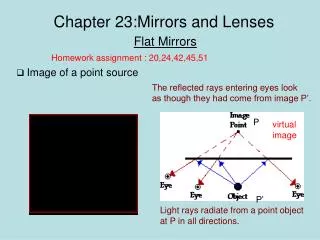
Image in a Flat Mirror Dobject =Dimagehobject= h image
Reflection in a curved mirror Light parallel to the principal axis reflects through the focus in a concave mirror. The same parallel light appears to come from the focus in the convex mirror.
Image in a Convex mirror Image = virtual, erect, smaller. Formed from diverging rays.
Images in a Concave mirror Image = Virtual, larger, erect
Images in a concave mirror No image forms
Images in a concave mirror If object is beyond the focal point = Real image, inverted, smaller, between the Center of curvature and focal point.
Concave Lenses Image = virtual, smaller, erect