Metadata Registries
This document provides an extensive insight into metadata registries, their purposes, and functionalities, including registering, publishing, and managing metadata schemas. It details how these registries facilitate navigation, searching, and querying through web interfaces and APIs. The presentation of examples like the DCMI Metadata Registry and the UKOLN schemas highlights the variety of registry types, such as cross-domain and project-specific registries. Gain an understanding of the role of metadata registries in knowledge organization systems and their contribution to data standards.

Metadata Registries
E N D
Presentation Transcript
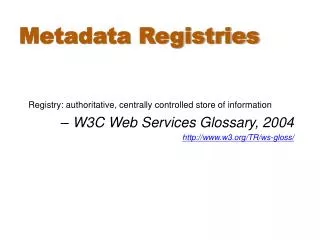
Registry: authoritative, centrally controlled store of information – W3C Web Services Glossary, 2004 http://www.w3.org/TR/ws-gloss/ Metadata Registries
Primary functions • Registering • Publishing • Managing • Data Storage • User Services via a Web Interface • Navigation • Searching • Browsing • M2M Services • Querying • Using an API to programmatically create, view, and modify contents • Crosslinking • Crosswalking • Schema translation And many more … …
ServiceRegistries “Metadata Registries” = metadata schemas Terminology Registries /Services = Knowledge Organization Systems (KOS) = encoding schemes = code sets = valid/permissible value lists Registry Types – Perspective 1 “DataRegistries” = data standards
Metadata Registries • Purpose: • to collect data related to metadata schemas • Functions: • to store data elements • include both semantics and representations • to provide the means • to identify and refer to established schemas and application profiles • to crosswalk and map among different schemas
Examples: Metadata Registries • Cross-domain and cross-schema registries, • e.g., UKOLN’s SCHEMAS Registry CORES Registry http://cores.dsd.sztaki.hu/ • JISC IE Metadata Schema Registry (IEMSR) project • Domain-specific, cross-schema registries, • e.g., UKOLN’s MEG (Metadata for Education Group) Registry • Australian Institute of Health and Welfare - Metadata Online Registry (METeOR) • Project-specific registries, • e.g. The European Library (TEL) metadata registry, whose purpose is recording all metadata activities associated with TEL • Standard-specific registries • e.g., DCMI Metadata Registry
http://www.cores-eu.net/registry/ http://cores.dsd.sztaki.hu/
Registry Practice 1 • Go to Cores Registry: http://cores.dsd.sztaki.hu/ • Explore: • Is a full MODS element set registered? • What elements from MODS are registered? By whom? • What elements are in the British Library Application Profile? • Is there any application profile available for postcards? • Is there an element ‘measurement’ in the registry?
Metadata Registries that IncludeSchemas and relatedEncoding Schemes
DCMI Open Metadata Registry http://dcmi.kc.tsukuba.ac.jp/dcregistry/navigateServlet
Open Metadata Registry Element Sets http://metadataregistry.org/ http://metadataregistry.org/schema/list.html
Value Vocabularies Concepts in a value vocabulary http://metadataregistry.org/
Registry Practice 2 • Go to DCMI Registry at: http://dcmi.kc.tsukuba.ac.jp/dcregistry/navigateServlet • Choose your “Language Preference” • View ‘properties’ and explain why there are two ‘contributors’ in the registry. • Where is “hasVersion” defined? What is the namespace URI? What property does it refine? • What ‘encoding schemes’ have been registered there? • What is “IMT”? Can you find the value for jpeg 2000?
http://lov.okfn.org/dataset/lov/index.html Upper & Meta Data & Systems Science Media Market Where & When City Library The LOV dataset contains the description of RDFS vocabularies or OWL ontologies defined for and used by datasets in the Linked Data Cloud.
Vocabularies included And a lot more …
About a vocabulary: Basic information; Relationship with others