Download
1 / 10
100 likes | 233 Vues
This document outlines the major topics covered in Unit 1, focusing on biomes, ecosystems, and plant adaptations. Students will review key concepts such as different biomes including desert, tundra, tropical rain forests, grasslands, coniferous forests, and deciduous forests. There is an emphasis on recognizing the characteristics of each biome and understanding how plants like the Venus flytrap adapt to their environments. Homework will involve preparing for the Unit 1 district assessment scheduled for September 26, 2011.

E N D
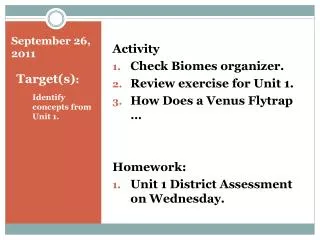
Activity • Check Biomes organizer. • Review exercise for Unit 1. • How Does a Venus Flytrap … Homework: • Unit 1 District Assessment on Wednesday. September 26, 2011 Target(s): Identify concepts from Unit 1.
Large areas of the Earth’s continents that share similar climates and soil types are … Ecosystems Populations Biomes communities
Christmas trees, such as spruces or pines, are members of this biome. Desert Tundra Tropical rain forest Grassland Coniferous forest Deciduous forest
Iowa cornfields are one example of this terrestrial biome. Desert Tundra Tropical rain forest Grassland Coniferous forest Deciduous forest
Which of the biomes is located just south of the Arctic icecap and is characterized by freezing temperatures and little sunlight? Desert Tundra Tropical rain forest Grassland Coniferous forest Deciduous forest
Which biome supports the greatest variety of life found anywhere on Earth? Desert Tundra Tropical rain forest Grassland Coniferous forest Deciduous forest
Unit 1 Review Exercise Directions: With your partner, match the yellow slips. Time Limit: 20 minutes
Directions: Match the description on the left with the letter of the correct term on the right. Write the letter on the line. Some letters may be used more than once. ______ 1. secrete a gluelike substance a. snap traps ______ 2. are also called pitcher plants ______ 3. have trigger hairs b. flypaper traps ______ 4. suck in insects ______ 5. have leaves that fold up, capturing prey c. lobster-pot traps ______ 6. have leaves that are rolled up, and insects fall in or crawl downd. pitfall traps ______ 7. along with pitfall traps, have hairs that grow in one direction ______ 8. grow in water or very wet areas e. bladder traps ______ 9. live in areas where there is little nitrogen in the soil _____10. are also called insectivores f. all traps
September 26, 2011 Target(s) Homework Identify concepts from Unit 1. District Assessment for Unit 1 on Wednesday.