ALTERNATIVE PUBLISHING MODELS
This document outlines the discussions from the CRKN AGM held in Toronto on September 25, 2007, focusing on alternative publishing models. The presentation explores inclusive approaches compared to traditional open access and conventional publishing, along with financial, operational, and evaluation considerations. Key topics include the impact of significant policy changes in Canadian scholarly publishing, potential modifications to CRKN's procurement process, and the necessity of a new evaluation framework. The overarching goal of CRKN and its capacity for risk assessment in the evolving publishing landscape are also examined.

ALTERNATIVE PUBLISHING MODELS
E N D
Presentation Transcript
ALTERNATIVE PUBLISHING MODELS CRKN AGM Toronto, Ontario Sept.25, 2007
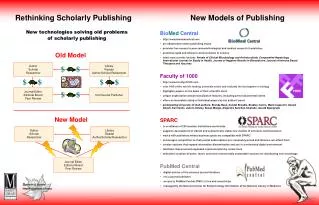
Alternative Publishing • More inclusive than open access • Conventional publishing includes commercial and society publishers
Models • Open access variations • Author fees • Co-operative model • Endowment
CRKN’s RFP Process • Procurement terms • Financial requirements • Business and operational requirements • RFP expertise • Risk assessment • Size issue • Model license • Evaluation Criteria and scoring
1. Significant policy developments in the Canadian scholarly publishing environment? • CIHR open access policy • Synergies • SSHRC open access pilot • Open Medicine, also Canadian Journal of Sociology
2. Can CRKN’s RFP process be modified? • Some alternative publishers are sufficiently mature • RFP-lite
3. Is a new evaluation process required? • Non-trivial • New procedures, criteria, etc. • Implications for organizational resources
4. Outcomes of a new evaluation process? • Memberships, investments, donations • “Stamp of approval” • Venture capital role, co-development
5. What is CRKN’s overarching goal? • Buying club • Tranformative role
6. Is CRKN the most appropriate group? • CRKN strengths • Conflict of interest • Dilution • A new CRKN “division”
7. How much risk? • Much higher risk • Indirect and more long term returns • CRKN ability to assume collective risk

![[Alternative Ownership Models]](https://cdn2.slideserve.com/5345939/alternative-ownership-models-dt.jpg)