Navigating Non-Transitive Connectivity in Distributed Hash Tables
250 likes | 344 Vues
This paper explores the challenges of non-transitive connectivity in DHTs, presents algorithmic solutions, and highlights the impact on routing and scalability in large-scale distributed systems.


Navigating Non-Transitive Connectivity in Distributed Hash Tables
E N D
Presentation Transcript
Non-Transitive Connectivity and DHTs Mike Freedman Karthik Lakshminarayanan Sean Rhea Ion Stoica WORLDS 2005
Distributed Hash Tables… k • System assigns keys to nodes • All nodes agree on assignment • Chord assigns keys as integers modulo 2160 • Assigns keys via successor relationship • Each node must know predecessor R
Distributed Hash Tables… k • Used to store and retrieve (key, value) pairs • Any node can discover key’s successor, yet without full knowledge of network • Implies some form of routing R
Distributed Hash Tables… • All have implicit assumption: full connectivity
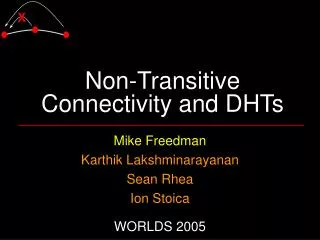
Distributed Hash Tables… • All have implicit assumption: full connectivity • Non-transitive connectivity (NTC)not uncommon B ↔ C , C ↔ A , A ↔ B • A thinks C is its successor! X A B C k
Does non-transitivity exist? • Gerding/Stribling PlanetLab study • 9% of all node triples exhibit NTC • Attributed high extent to Internet-2 • Yet NTC is also transient • One 3 hour PlanetLab all-pair-pings trace • 2.9% have persistent NTC • 2.3% have intermittent NTC • 1.3% fail only for a single 15-minute snapshot • Level3 ↔ Cogent, but Level3 ↔ X ↔ Cogent • NTC motivates RON, Detour, and SOSR!
Our contributions • We have built and run Bamboo (OpenDHT), Chord (i3), Kademlia (Coral) for > 1 year • Vanilla DHT algorithms break under NTC • Identify four main algorithmic problems and present our solutions
Our goals • Short-term • Inform other developers about NTC solutions • Important: DHTs are being widely deployed in Overnet, Morpheus, and BitTorrent • Long-term • Encourage new designs to directly handle NTC • (This topic is far from solved)
A B k R S DHTs 101: Routing • Key space defines an identifier distance • Routing ideally proceeds by halving distance to destination per overlay hop Iterative
A B k R S A B k R S DHTs 101: Routing Iterative Recursive
DHTs 101: Routing tables • successors / leaf set: ensure correctness • fingers / routing table: efficient routing • O ( log (n) ) hops, generally k R
Problems we identify • Invisible nodes • Routing loops • Broken return paths • Inconsistent roots
NTC problem fundamental? S A B C R Traditional routing
NTC problem fundamental? S A B C R • DHTs implement greedy routing for scalability • Sender might not use path, even though exists: finds local minima when id-distance routing Greedy routing Traditional routing
Problems we identify • Invisible nodes • Routing loops • Broken return paths • Inconsistent roots (First discuss how problems apply to iterative routing, then consider recursive routing.)
Iterative routing: Invisible nodes B C k A R X S • Invisible nodes cause lookup to halt
Iterative routing: Invisible nodes X B C D k A R X S • Invisible nodes cause lookup to halt • Enable lookup to continue • Tighter timeouts via network coordinates • Lookup RPCs in parallel • Unreachable node cache
Routing table pollution B C k A R S • Many proposals for maintaining routing tables • E.g., replace nodes with larger RTT • Must first prevent routing table pollution • Only add new nodes upon contacting directly • Do not immediately remove nodes from hearsay
Inconsistent roots • Nodes do not agree where key is assigned: inconsistent views of root • Can be caused by membership changes • Also due to non-transitive connectivity • May persist indefinitely k R S’ ? X S R’
Inconsistent roots • No solution when network partitions • If non-transitivity is limited: • Consensus among leaf set? • [Etna, Rosebud] • Expensive in messages and bandwidth • Link-state routing among leaf set? • [Pastry 1.4.1] • Can use application-level solutions!
Inconsistent roots • Root replicates (key,value) among leaf set • Leafs periodically synchronize • Get gathers results from multiple leafs • [OpenDHT, DHash] • Not applicable when require fast update (i3) k R X S R’ M N
Recursive routing • Invisible nodes • Must also prevent routing table pollution • Easier to achieve accurate timeouts • Harder to perform concurrent RPCs • Inconsistent Roots • Similar solutions • (Routing Loops) • One new problem…
Broken return paths • Direct path back from R to S fails • Source-route reverse path • Use single intermediate hop • RON, Detour, SOSR… k R X S T
Summary • Non-transitive connectivity exists • DHTs must deal with it • Discovered problems the “hard way” • OpenDHT / Bamboo, i3 / Chord, Coral / Kademlia • Presented our “from the trenches” fixes • NTC should be considered during design phase
Thanks… Watch Our Real, Large Distributed Systems… coralcdn.org opendht.org i3.cs.berkeley.edu